How to Calculate Net Income on a Balance Sheet

A balance sheet reports position at one date, not the profit earned over a period. Here is where net income actually lives, when retained earnings can reconcile it, and what breaks the shortcut.
Short answer: one balance sheet will not give you period net income
A single balance sheet generally does not provide enough information to calculate the period's net income. It reports assets, liabilities and shareholders' equity as of the end of the reporting period and does not show the flows into and out of those accounts during the period, while net income is the income statement measure: revenue minus expenses. With two consecutive balance sheets for the same entity, period boundaries and accounting basis, plus the dividends declared for the period, taken from the equity statement or the ledger rather than from either balance sheet, you can usually work back to it as net income = ending retained earnings - beginning retained earnings + dividends declared, provided nothing else moved retained earnings in between. Assets minus liabilities gives equity, which is a value held at a date rather than a period's profit.
Where net income is actually reported
Net income belongs to the income statement, which can be summarized as revenue minus expenses equals net income or loss. That statement measures financial performance over a span of time. The balance sheet measures financial position at a point in time through assets, liabilities and owners' equity. Both are needed, and the SEC's investor guide makes the point plainly: the statements are related, and no single one tells the complete story.
So the practical first step is dull but decisive. If you can reach the ledger that produced the balance sheet, pull the profit and loss report for the same date range and read net income there. Everything below is a cross-check for the cases where that report is missing, or where you want proof that the two statements agree.
Why assets minus liabilities is equity, not profit
Subtract liabilities from assets and you get equity, the third element the balance sheet reports at a specific date such as December 31. Changes in assets and liabilities raise or lower that value depending on the net result of each transaction, and only some of those transactions run through an income statement account at all.
Take a hypothetical company. At the end of Year 2 it holds $610,000 of assets and owes $350,000, so equity is $260,000. Its net income for Year 2, worked out further down, is $92,000. The two numbers describe different things. The $260,000 is the owners' book equity on that date; the $92,000 is what the business earned in twelve months. Calling the first figure profit would overstate the year by $168,000.
The retained earnings method and the conditions it depends on
For a corporation, retained earnings appears as a separate line inside the stockholders' equity section of the balance sheet. Generally speaking, that line reports net income from the company's inception to the balance sheet date, less the dividends declared over the same span. At the end of an accounting year the revenue, gain, expense and loss balances are used to compute net income and are transferred into retained earnings, so a positive result increases the balance, a net loss reduces it, and declaring a cash dividend reduces it as well.
Rearranged for the figure you want:
Net income = ending retained earnings - beginning retained earnings + dividends declared
The reconciliation holds only when all of these are true:
Both balance sheets belong to the same reporting entity, and the second date picks up exactly where the first leaves off, with no gap or overlap.
Both are prepared on the same accounting basis, so you are not mixing cash-basis and accrual-basis figures.
The dividend input is the amount declared during the period, not the cash that happened to leave the bank.
Nothing else was posted to retained earnings during the period.
Check that last condition before relying on the result. Use the reconciliation to cross-check the income statement.
Worked example: reconciling two balance sheets
Every figure below is hypothetical.
The Year 1 balance sheet, dated December 31 of Year 1, shows $520,000 of assets and $322,000 of liabilities, so equity is $198,000: common stock of $18,000 plus retained earnings of $180,000.
The Year 2 balance sheet, dated December 31 of Year 2, shows $610,000 of assets and $350,000 of liabilities, so equity is $260,000: the same $18,000 of common stock plus retained earnings of $242,000.
The board declared $30,000 of cash dividends during Year 2. That input comes from the equity statement or the ledger, not from either balance sheet.
Net income = $242,000 - $180,000 + $30,000 = $92,000.
Run it forward to confirm. Beginning retained earnings of $180,000, plus net income of $92,000, less declared dividends of $30,000, equals $242,000, which is the ending balance on the second statement. Total equity ties out the same way: $198,000 plus $92,000 less $30,000 equals $260,000, because no stock was issued or repurchased in this hypothetical year.
If the Year 2 income statement differs from $92,000, compare the inputs and investigate the gap before relying on either result. Check the period, accounting basis, rounding and any other retained earnings movements.
Which statement answers which question
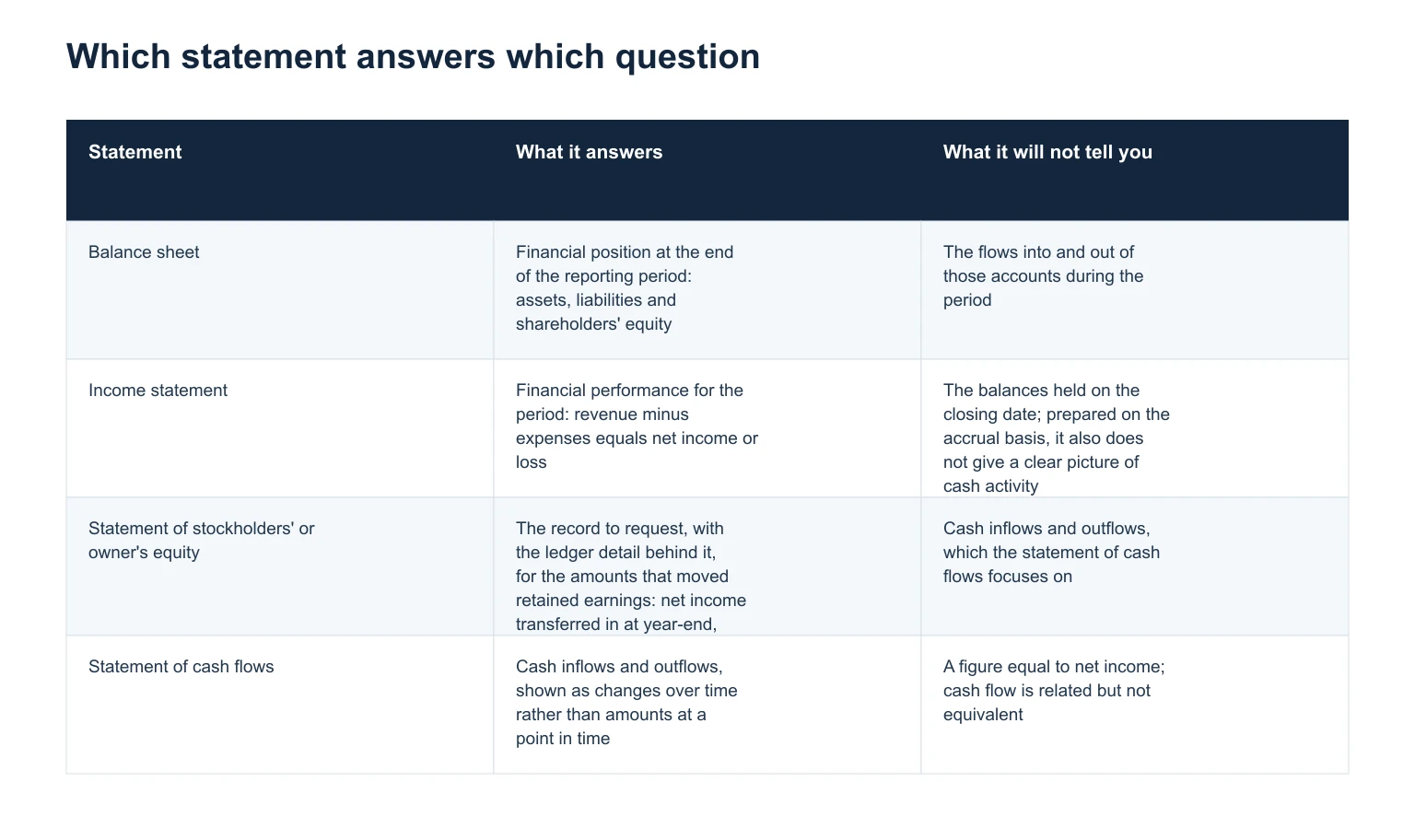
A four-row comparison pairing the balance sheet, income statement, equity records and cash flow statement with the question each one answers and the question it cannot answer on its own.
Statement: Balance sheet; What it answers: Financial position at the end of the reporting period: assets, liabilities and shareholders' equity; What it will not tell you: The flows into and out of those accounts during the period
Statement: Income statement; What it answers: Financial performance for the period: revenue minus expenses equals net income or loss; What it will not tell you: The balances held on the closing date; prepared on the accrual basis, it also does not give a clear picture of cash activity
Statement: Statement of stockholders' or owner's equity; What it answers: The record to request, with the ledger detail behind it, for the amounts that moved retained earnings: net income transferred in at year-end, cash dividends declared, and direct debits such as a below-cost treasury stock sale; What it will not tell you: Cash inflows and outflows, which the statement of cash flows focuses on
Statement: Statement of cash flows; What it answers: Cash inflows and outflows, shown as changes over time rather than amounts at a point in time; What it will not tell you: A figure equal to net income; cash flow is related but not equivalent

Dates carry the reconciliation: the two statements have to sit on consecutive period boundaries.
What breaks the shortcut
Dividends declared versus dividends paid: the retained earnings balance drops when the corporation declares a cash dividend, so a dividend declared in December and paid in January belongs to the earlier period. Swapping in a cash payment figure shifts the derived net income by the timing difference.
Debits posted straight to retained earnings: some equity transactions never touch an income statement account. When treasury stock is sold below cost, the shortfall is charged against paid-in capital from treasury stock first, and any excess is debited to retained earnings. The balance falls, and no loss appears in profit.
Anything else in the account: net income and declared dividends are the common movements, not the only ones an entity can record. If the retained earnings line moved for a reason the equity statement does not explain as profit or dividends, the reconciliation is unreliable for that period.
None of this makes the method useless. It means the single retained earnings line on a balance sheet is not enough on its own. Ask the ledger or the equity records for the amounts behind the movement: the net income transferred in at year-end, the cash dividends declared, and any direct debit such as the one recorded when treasury stock is sold below cost.
When the balance sheet has no retained earnings line
The retained earnings line used above belongs to a corporation, where it is reported as a separate line within the stockholders' equity section of the balance sheet. Do not assume an unincorporated business presents a line carrying that same label.
Where no such line exists, the reconciliation has nothing to work from, and the answer is the one from the top of this guide. Ask for the income statement covering the period, since that is where net income is reported as revenue minus expenses, and read it alongside the balance sheet. The statements are related, and no single one tells the complete story.
Net income is not cash flow
Cash flows are related to the net income shown on the income statement, but they are not equivalent to it. A cash flow statement shows changes over time rather than absolute amounts at a point in time, reordering information that already sits in the balance sheet and income statement.
When the income statement, statement of owner's equity and balance sheet are prepared using accrual accounting, they do not by themselves give a clear picture of the business's cash activities; the statement of cash flows fills that gap by focusing on cash inflows and outflows. In the hypothetical above, a $92,000 net income year says nothing definite about whether the bank balance rose or fell.
When the prior balance sheet is missing
Ask for the income statement covering the exact period first. It reports the figure directly, so start there before attempting a reconciliation.
If only one balance sheet exists, request the prior period's closing balance sheet or trial balance from the ledger, the tax workpapers, or whoever kept the books before you.
Ask the ledger or the equity records, including the statement of stockholders' or owner's equity, for the amounts behind the retained earnings movement: net income transferred in at year-end, cash dividends declared, and any direct debit such as a below-cost treasury stock sale.
If none of that is available, record the limitation instead of estimating around it. One balance sheet does not display period flows, so a figure derived from it alone is an assumption rather than a calculation.
Books clean enough to trust the numbers
A reconciliation is only as good as the ledger beneath it. When bank feed items sit uncategorized or documents stay unmatched at the closing date, both the retained earnings line and the income statement can move after you have finished the arithmetic.
Booke AI works inside the bank feeds already connected to QuickBooks Online, so there is no extra bank connection or separate ledger to manage. QuickBooks Online remains the accounting system of record, the firm provisions AI Bookkeeper as a user, and people keep final review and close responsibility. Booke's own framing is that bookkeeping automation is a workflow decision rather than one feature: an implementation has to define where the work happens, which records are eligible, what evidence is required, and when a person reviews the result. That review step is what makes a period-end number defensible. The bookkeeping automation software page covers how that works in the bank feed, and the AI bookkeeping page explains how the operating models differ.
The accounting sources behind this guide were last checked on September 9, 2026.
Frequently asked questions
Can I calculate net income from a single balance sheet?
Not as a rule. One balance sheet reports balances at the end of the reporting period and does not show the flows into and out of those accounts during the period. With the prior period's balance sheet and the dividends declared, you can reconcile the retained earnings movement instead.
Do I use dividends declared or dividends paid?
Declared. Retained earnings falls when the corporation declares a cash dividend, so a dividend declared in December and paid in January belongs to the earlier period's reconciliation. Substituting the cash paid moves the derived net income by that timing difference.
Why doesn't assets minus liabilities equal my profit?
That residual is equity, the value element the balance sheet reports alongside assets and liabilities at a specific date such as December 31. Generally speaking, the retained earnings line inside equity reports net income from inception to the balance sheet date less the dividends declared over that span. Net income covers a single period and is measured on the income statement as revenue minus expenses.
Is net income the same as the cash in my bank account?
No. Cash flows are related to net income without being equivalent to it, and the cash flow statement reports changes over time rather than balances at a date. When the other statements are prepared using accrual accounting, they do not show cash activity clearly on their own.
My reconciled figure doesn't match the income statement. What now?
Compare the income statement with your reconciliation and investigate the gap. Check whether the dividend input mixes declarations with payments, then look for entries posted straight to retained earnings, such as the debit recorded when treasury stock is sold below cost. Ask the ledger or the equity records for those amounts.
Explore Booke AI workflows
Sources
Beginners' Guide to Financial Statements (U.S. Securities and Exchange Commission)
Principles of Accounting, Volume 1, Section 2.1: How the financial statements interrelate (OpenStax)
Stockholders' Equity: In-Depth Explanation with Examples (AccountingCoach)
Bookkeeping automation software for QuickBooks Online (Booke AI)