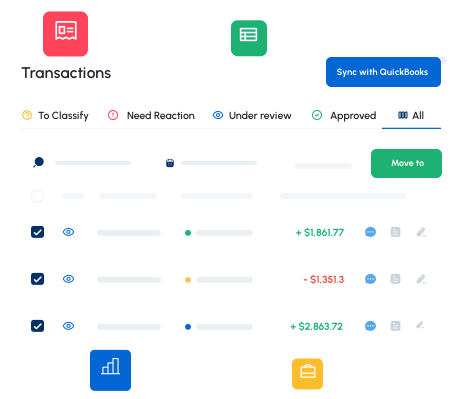
AI Bookkeeping for Xero: How Transaction Reconciliation Works

Xero stays the system of record. Here is how an AI bookkeeping layer reads the connected bank feed, proposes categories, pairs payments with documents, and hands everything else back to a person.
AI bookkeeping for Xero means a software layer works on the bank feed already connected to Xero: it proposes a category for eligible transactions, pairs payments with the bills and invoices it can find, and sends anything unclear to a person. Xero stays the accounting system of record, and Booke describes the firm provisioning AI Bookkeeper as a user while people keep final review and close responsibility. Xero states that you decide what runs on its own and that everything Xero does is recorded for your review, and Xero's guide for accountants and bookkeepers says people still need to provide oversight and use their judgment. The software prepares and proposes; the reviewer decides.
What AI bookkeeping for Xero means
Start with the underlying job. Bank reconciliation means comparing your own record of transactions against the bank's records so the entries match, which Xero's bookkeeping guide describes as quality control on the books. Categorization is the decision sitting underneath that comparison: a bank line needs an account and a payee before there is anything meaningful to reconcile.
AI bookkeeping covers several operating models, and it pays to check which one a vendor is selling before comparing feature lists. QuickBooks Online or Xero remains the system of record, and AI Bookkeeper works with the bank feeds already connected there, so there is no second ledger and no extra bank connection to maintain. Booke's AI bookkeeper for Xero page describes the tool operating directly within Xero, following expert bookkeeper workflows and completing workflow steps that would otherwise stay manual.
How does an AI bookkeeper work with Xero?
The stages below follow Booke's published description of AI Bookkeeper in Xero.
Provisioning: the firm adds the tool as a user against the existing Xero file, and bank feeds stay where they are.
History: Booke states that AI Bookkeeper learns from up to two years of transaction history and picks up the categorization patterns and accounting preferences already in the file.
A daily run: Booke states that automation runs daily and that each approval and correction is used to improve future work. Nothing here is instant, and review decisions stay with your team.
Proposed categories: learned patterns are applied to new transactions before reconciliation review, including new vendors categorized from historical patterns.
Document pairing: payments are paired with the corresponding bills and invoices where the evidence supports it.
Exceptions: low-confidence transactions go to your team, with suggestions attached for unclear entries.
Approval: your team makes the review decisions. Booke also shows read-only AI Bookkeeper statuses beside bank transactions through its browser extension, which display state rather than change records in Xero.
Xero's own automation, the AI layer, and your team

Five reconciliation stages compared across three columns: what Xero states about its own automation, what Booke states AI Bookkeeper does inside the connected Xero bank feed, and the work that stays with your team. The Xero column quotes its US guidance; confirm current availability for your account.
Workflow stage: Bank feed; Xero states: Connect bank accounts to Xero; Xero reconciles transactions automatically; Booke states: Works in the bank feed already connected to Xero, with no separate ledger; Stays with your team: Confirming the feed is complete for the period
Workflow stage: Categorization; Xero states: You decide what runs on its own; everything Xero does is recorded for your review; Booke states: Learns from up to two years of history and categorizes new vendors from past patterns; Stays with your team: Approving or correcting the proposed account and payee
Workflow stage: Documents; Xero states: Your entries should match up with the bank's records; Booke states: Automatically pairs payments with corresponding bills and invoices; Stays with your team: Partial payments, splits, and anything without evidence
Workflow stage: Exceptions; Xero states: You decide what runs on its own; Booke states: Brings low-confidence transactions to your team with suggestions attached; Stays with your team: Deciding treatment and chasing the client for missing paperwork
Workflow stage: Sign-off; Xero states: Everything Xero does is recorded for your review; Booke states: Shows read-only statuses beside bank transactions via the browser extension; Stays with your team: Final review and close responsibility
How are Xero bank-feed transactions reviewed?
Review is a sorting job. Items the software handled with confidence arrive as a batch to scan and approve; items it would not decide arrive separately, with a suggestion and the reason it stopped short. Booke describes both halves: eligible transactions categorized and documents matched, low-confidence transactions brought to your team, and review decisions kept with your people.
What a reviewer checks on the confident batch is usually narrow. Does the account match how this payee has been treated all year? Is the payee itself right, or is it a lookalike vendor? Does the amount belong in this period? For the exception pile, the questions are the ones software cannot answer anyway: whose card this was, what the payment covered, whether an owner drawing has been coded as an expense.
Booke's browser extension shows read-only statuses beside bank transactions, so a reviewer can see the state of an item and open the related detail in Booke instead of guessing. Xero, separately, states that everything it does is recorded for your review.
How does categorization work when no bank rule covers the payee?
Deterministic rules repeat a decision someone already made. They work well for the same utility bill every month and do nothing for a payee nobody has coded before.
That gap is what pattern-based categorization targets. Booke states that AI Bookkeeper learns from up to two years of transaction history, understands the categorization patterns and accounting preferences in the file, and categorizes new vendors from those historical patterns, applying them before reconciliation review. Thin or inconsistent history changes the result. Booke is explicit that coverage depends on client history, transaction complexity, document availability, platform configuration, and accounting policy, so a file coded three different ways in eighteen months will produce more items for you to decide.
For the step-level mechanics of coding a line in Xero itself, the sibling guide on how to categorize transactions in Xero covers the detail this article summarizes.

Keep unresolved items separate for a reviewer to investigate.
How receipts and bills get matched to bank transactions
Matching turns a bank line into evidence-backed bookkeeping. Booke states that AI Bookkeeper automatically pairs payments with corresponding bills and invoices, and that this removes the need to undo categorizations in order to match a payment later, one of the small repeated frustrations of feed work.
Matching is not universal. The base flow keys on amount, currency, and date agreeing, so partial payments, split allocations, and payments covering several invoices at unusual amounts stay with a person. Nothing in this workflow produces a document that does not exist. If you also need capture and extraction upstream of the match, that sits with invoice and receipt OCR rather than with the matching step.
Missing documents and reconciliation exceptions
An exception queue is part of the design. Booke describes routing exceptions and bringing low-confidence transactions to the team, with suggestions attached for unclear entries.
The common ones fall into a few groups. A payment with no bill or receipt anywhere in the file needs a document from the client, and Booke is direct that AI bookkeeping does not make missing evidence irrelevant: the gap gets flagged and a person obtains the paperwork. A transfer between two accounts belonging to the same business is a treatment decision, not a coding lookup. A duplicate charge needs someone to confirm with the bank or the vendor before anything is written off. A payment split across periods or across several invoices needs an allocation someone can defend later.
What the queue buys you is a shorter list of named problems instead of an undifferentiated feed. Booke's stated position is that repeatable work is handled within a defined scope while unresolved work stays visible to people, and that professional responsibility does not transfer to software.
Where do the time savings in Xero reconciliation come from?
Three mechanisms sit behind the difference on a Xero file.
Repetition is the first. A file with hundreds of lines from forty recurring payees holds very little novel decision-making, and that is exactly the volume a learned pattern handles well. The second is rework avoided: Booke states that its matching removes the need to undo categorizations to match a payment. The third is cadence. A daily run spreads review across the month instead of leaving a backlog to work through at once.
How much of that lands on your own files is conditional. Booke states that coverage depends on client history, transaction complexity, document availability, platform configuration, and accounting policy, so the same three mechanisms produce different results on different clients.
Keeping oversight when software proposes the categories
Xero's guide for accountants and bookkeepers states that AI tools can take care of certain regular tasks such as bank reconciliation, and that human accountants and bookkeepers still need to provide oversight and use their judgment. Xero also states that you decide what runs on its own and that everything Xero does is recorded for your review.
On the Booke side, review decisions stay with your team, the firm provisions the tool as a named user, and the browser extension displays read-only statuses beside bank transactions with an explanation attached to each state. In practice that means someone on your team can see the status displayed for a supported bank-feed item, read the explanation attached to that state, and open the related detail in Booke when a reviewer or a client asks why an item sat in the exception queue.
What should you check before relying on it?
Availability is conditional. Booke states that what you get depends on the connected platform, account configuration, subscription, and current product release, so confirm the specifics for your own firm rather than assuming everything described here is switched on.
The two platforms are also not interchangeable. Booke states that the QuickBooks Online and Xero workflows follow the same controlled automation principles but that their supported reconciliation scope differs, and that each should be evaluated on its own terms. A demo built on a QuickBooks Online file will not tell you what your Xero files do.
Xero's US bank reconciliation page describes JAX, its AI finance partner, categorizing and matching transactions, and states it is available on the Growing price plan and above.
How to evaluate an AI bookkeeper for Xero
Run the assessment on your own files, with questions a vendor has to answer specifically.
Where do the books live, and does anything create a second ledger or a second bank connection?
Which records are eligible, and which are excluded by design?
What evidence must exist before an item is treated as matched?
Which items always reach a person, and at which step?
What happens on a client whose history is thin, inconsistent, or recently converted?
How does the Xero scope differ from the QuickBooks Online scope for the same vendor?
What stays visible afterwards when a partner or a client asks why an item was coded the way it was?
Test with one messy file rather than a clean one. For the product-level detail behind the workflow described here, Booke's AI bookkeeper for Xero page covers it, and bookkeeping automation software covers the wider automation decision across both platforms.
Questions accountants ask
Does an AI bookkeeper replace Xero?
No. Booke states that QuickBooks Online or Xero remains the accounting system of record and that AI Bookkeeper works with the bank feeds already connected there, with no separate ledger and no extra bank connection.
Does it replace the reviewer?
No. Booke states that the firm provisions the tool as a user while people keep final review and close responsibility, and Xero's guide for accountants and bookkeepers states that people still need to provide oversight and use their judgment.
Is reconciliation done in real time?
No. Booke states that its automation runs daily and that each approval and correction is used to improve future work. Items still reach a reviewer before they are approved.
What happens when a receipt is missing?
The gap is flagged and a person obtains the document from the client. Booke states plainly that AI bookkeeping does not make missing evidence irrelevant, and unresolved work stays visible to people.
Will every payment match to a bill or invoice automatically?
No. Booke states that AI Bookkeeper automatically pairs payments with corresponding bills and invoices, but the base flow depends on amount, currency, and date agreeing, so partial payments and split allocations stay with a person.
Is the Xero workflow the same as the QuickBooks Online one?
No. Booke states that both follow the same controlled automation principles while their supported reconciliation scope differs, and that each workflow should be evaluated on its own terms. Availability also depends on platform, account configuration, subscription, and current release. For what the AI built into QuickBooks Online and Xero does in reconciliation, side by side, see AI bank reconciliation in QuickBooks Online and Xero.
Sources and availability
Sources checked on 4 September 2026. Confirm current plan and feature availability before applying the workflow to a client file.
Explore Booke AI workflows
Sources