AI in Accounting Statistics 2026: Adoption, Automation & Human Oversight
Booke AI · Research synthesis
Evidence checked: September 13, 2026
AI is already part of accounting work. Headline percentages reveal far less about how much work it completes and who remains responsible when something goes wrong.
The research below separates occasional use from embedded workflows, AI assistance from autonomous execution, and measured results from expectations. The surveys document substantial AI use, but they do not provide a universal percentage of accounting work completed without human involvement. [1] [2] [3]
This 2026 evidence review includes observations collected before 2026. Some reports published this year use 2025 responses; historical findings are labeled accordingly. The focus is accounting and bookkeeping practice, with corporate reporting and tax research included where their scope is explicit.
Key AI accounting statistics at a glance
Finding | Population and source |
|---|---|
88% reported using AI for at least one client service in the previous year. | US accounting and bookkeeping professionals; Intuit, May 2026. [1] |
30% described AI as the default in day-to-day work. | Respondents to the same Intuit survey; a measure of reported workflow depth. [1] |
52% reported regular AI use in their role. | ACCA's international accountancy and finance respondents, 2026 report. [2] |
34% reported organizational GenAI use. | Thomson Reuters' tax-firm respondent group; survey conducted in late 2025. [3] |
39% reported current GenAI use, with another 31% piloting it. | FRC/Lancaster corporate-reporting research, February–April 2026. [4] |
53% used GenAI for accounting/bookkeeping. | Current GenAI users in Thomson Reuters' Tax & Accounting segment—not all accountants. [3] |
AI assistance improved classification accuracy by approximately 17.5 percentage points in a randomized experiment. | Choi and Xie's 99-accountant task experiment; final journal article, 2026. [6] |
19% said their organization measured the ROI of AI tools. | Thomson Reuters' tax-firm respondent group. [3] |
6% preferred autonomous AI execution for client work and deliverables. | Intuit's US survey; a preference, not an actual automation rate. [1] |
44% had mandated human oversight, according to the FRC's research summary. | Companies represented in its corporate-reporting survey; not a global firm benchmark. [4] |
Each figure answers a different question. Combining them into one industry adoption rate or arranging them as stages in a single funnel would erase those differences.
How many accountants use AI in 2026?
The studies report several adoption rates because they measure different populations and forms of use.
Intuit's US survey measures use during a twelve-month window. ACCA asks about regular use in a professional role. Thomson Reuters separates organizational GenAI adoption from individual behavior. The FRC focuses on corporate reporting rather than the entire workload of an accounting practice. [1] [2] [3] [4]
A person who uses AI to summarize a document and a firm that incorporates it into transaction processing can both count as adopters, although their operating models differ substantially.
Why the population matters
Study | Overall research population | What to remember |
|---|---|---|
Intuit, 2026 | 725 US accounting/bookkeeping professionals | A commissioned, compensated online sample; respondents are not a verified census of distinct firms. |
ACCA, 2026 | 11,389 respondents across 160 countries | Individuals in accountancy and finance across sectors; practice-group percentages do not describe every firm. |
Thomson Reuters, 2026 | 1,514 professionals across 27 countries | Multiple professions; use the tax/accounting subgroup rather than relabeling the entire sample. |
FRC/Lancaster, 2026 | 103 survey responses, plus 39 interviews | UK corporate-reporting research; interview participants and survey respondents are separate evidence components. |
Sources and sampling details: [1] [2] [3] [4]. Overall sample sizes must not be reused as the denominator for every subgroup or question.
Even a large survey can answer the wrong question for a particular reader. A US bookkeeping firm needs to know whether a statistic describes comparable practices, corporate tax departments, or listed-company reporting teams. Geography alone cannot settle that distinction.
What differs by accounting practice type?
Within ACCA's single research program, regular AI use differs between Big Four, mid-tier, and small-practice respondents. Figure 1 keeps those categories within the same study instead of constructing a league table from unrelated sources. [2]
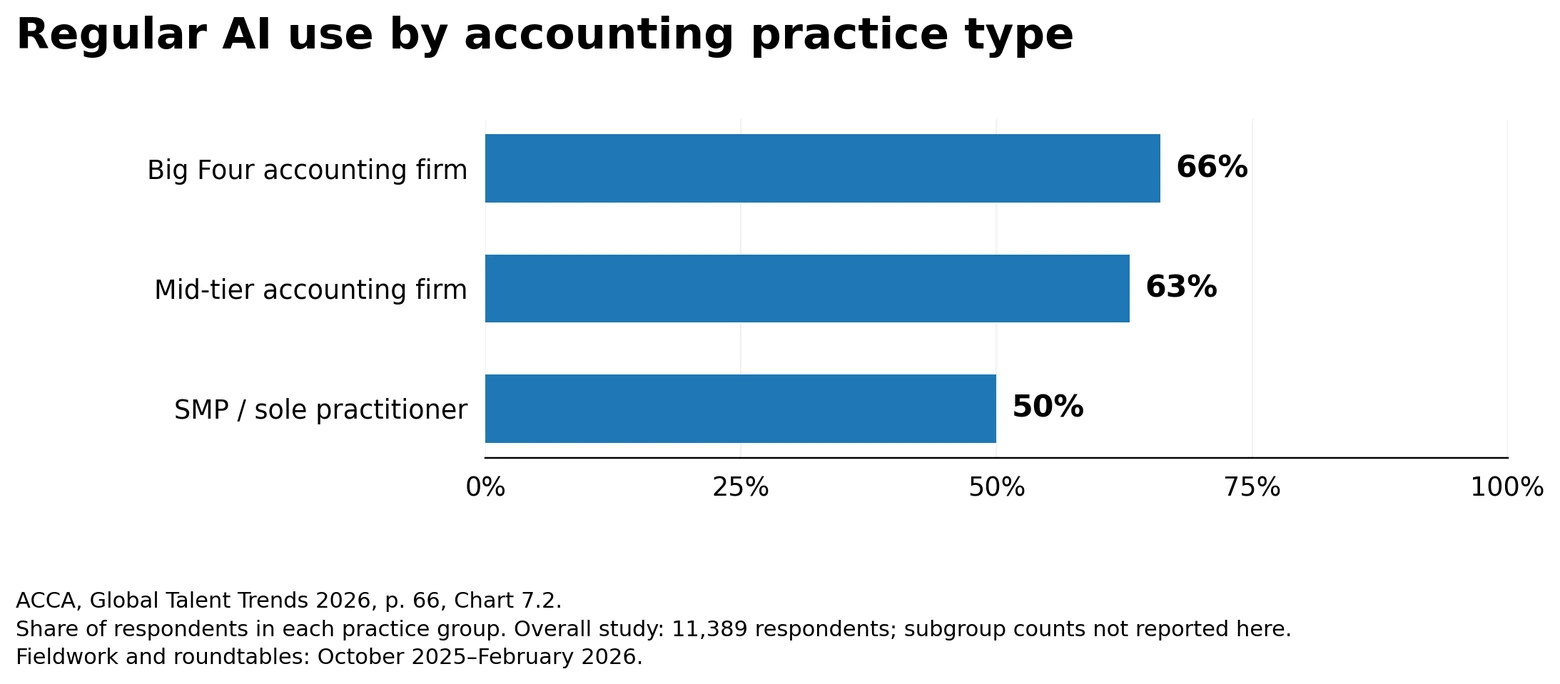
Figure 1. Regular AI use among respondents in three accounting-practice groups. Source: ACCA, Global Talent Trends 2026, p. 66, Chart 7.2. The chart omits subgroup sample sizes. “SMP” means small and medium-sized practice. [2]
These descriptive differences help identify questions for further study. They show neither that firm size causes adoption nor that more frequent AI use necessarily produces better accounts.
How deeply is AI embedded in accounting workflows?
Reported use is broader than routine integration.
In Intuit's survey, alongside the respondents who described AI as their everyday default, 54% reported situational use. Separately, 86% said they used AI for at least one firm operation. These figures describe behavior and workflow depth; transaction-level completion falls outside their scope. [1]
Workflow design reveals the difference. Asking a tool to help with an unusual email is a discrete use. An embedded process runs consistently, exposes exceptions, records corrections, and has a clear owner.
A historical example of the adoption gap
KPMG's 2024 research across 1,800 companies in ten markets reported 72% piloting or using AI in financial reporting, while 10% described wide adoption. Its fieldwork took place in February–March 2024. The results describe historical deployment rather than current 2026 penetration. [5]
The FRC's newer corporate-reporting findings also distinguish current use from pilots. Across both studies, pilot activity and completed transformation remain separate measures. [4] [5]
Four measurements that should stay separate
Measurement | The question it answers | What it does not establish |
|---|---|---|
Individual use | Has this person used an AI tool? | Whether their employer has deployed a controlled workflow |
Workflow integration | Is AI a routine part of a defined process? | How many items finish without intervention |
Task automation | Which steps does the system perform? | Whether the entire accounting outcome is complete |
End-to-end completion | Did an item reach the defined endpoint without a human touch? | Whether its accounting treatment was independently verified |
This four-part framework is the article's editorial synthesis; survey providers use their own models.
For example, extracting an invoice, suggesting an account, obtaining approval, and posting the result are separate events. An extraction success rate alone leaves approval, posting, and the quality of the final accounting treatment unresolved.
Which accounting tasks use generative AI?
Research and document work feature prominently, alongside bookkeeping and tax preparation, among existing GenAI users.
Thomson Reuters' Tax & Accounting segment reports the use cases shown in Figure 2. The denominator is current GenAI users in that segment. [3]
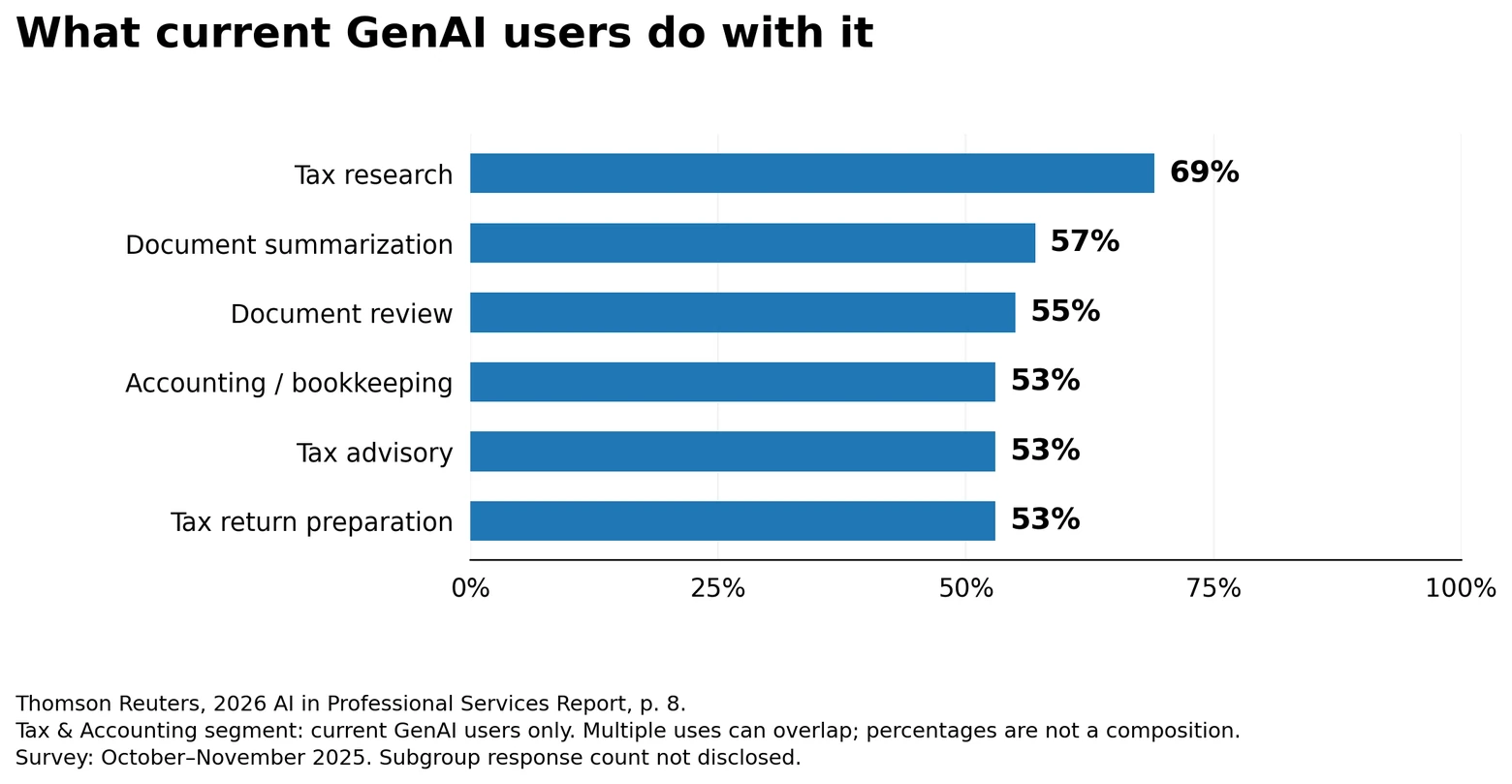
Figure 2. Selected GenAI use cases among current users. Respondents can use GenAI for several purposes, so the percentages are not additive. Source: Thomson Reuters, 2026 AI in Professional Services Report, p. 8; fieldwork October–November 2025. [3]
Using GenAI “for bookkeeping” may cover one component of the workflow. The survey does not establish whether a tool categorized, approved, and posted every transaction or how often a professional checked the result.
AI accounting is not one technology
The evidence spans several distinct capabilities. The following examples form a workflow taxonomy, separate from measured market shares or claims about every product.
Capability | Illustrative accounting role | The boundary to check |
|---|---|---|
Rules and robotic process automation | Transfer data or execute predefined steps | Deterministic automation is not automatically AI |
Machine learning | Suggest classifications or identify unusual patterns | A prediction is not a confirmed accounting conclusion |
Document extraction | Turn a document into structured fields | Recognizing an amount is not approving its treatment |
Generative AI | Draft, summarize, explain, or support research | Plausible prose still needs source verification |
Agentic AI | Coordinate multiple steps toward a goal | Ability to act must be separated from permission to act |
FRC guidance distinguishes content generation from systems that orchestrate and execute multiple tasks with some autonomy. Its corporate-reporting research also separates technologies and describes controlled use within existing reporting processes. [4] [7]
Evaluation therefore starts with three operational questions: Which step does the software perform, what evidence does it use, and what remains unresolved after it runs?
How common are AI agents in accounting?
Agents appear in the survey evidence, but the findings stop short of widespread autonomous bookkeeping.
ACCA reports that 31% of respondents said their organization was deploying agents for finance/accounting. Thomson Reuters reports 14% organizational agentic-AI use in its tax-firm respondent group. The populations, wording, and observation periods differ. [2] [3]
An agent can perform a bounded sequence while still requiring authorization at a control point. That matches the FRC's definition: agentic systems can coordinate multiple tasks toward a goal, while human involvement can direct, authorize, or review activity. [7]
For a firm evaluating an agent, the critical boundary appears when the system encounters missing evidence, contradictory information, a restricted accounting period, or an action beyond its authority. The ability to stop and explain an exception is materially different from simply generating a confident answer.
These agent-adoption percentages concern organizational use. The proportion of books closed without an accountant falls outside both measures.
Does AI improve accounting productivity and accuracy?
A randomized accounting-task experiment found an accuracy improvement, while broader productivity findings require careful interpretation.
Choi and Xie's final 2026 Journal of Accounting Research article combines a survey of 277 accountants, platform records for 79 SME clients, and a separate experiment involving 99 accountants. These are three evidence components within one research program. [6]
What the experiment established
The experiment assigned 52 accountants to AI assistance and 47 to a control group. Each completed 43 transaction-classification tasks. AI assistance improved classification accuracy by approximately 17.5 percentage points. The authors found no statistically significant average effect on completion time. [6]
The accuracy result and the time result belong in the same account of the experiment. Higher accuracy mattered for the assigned task, while average completion time showed no statistically significant change. A statistically non-significant time estimate also leaves open whether AI saves time in other tasks or settings.
The reported accuracy improvement is a difference between experimental conditions for a particular task and sample. It provides neither an overall ledger accuracy rate nor support for claims such as “AI accounting is 99% accurate.” It is also unrelated to Booke-specific performance.
What the observational evidence suggests
In the survey analysis, a one-standard-deviation increase in AI use was associated with approximately 19% more clients supported weekly and a 2.6-percentage-point lower share of time spent on data entry. These are associations with usage intensity. Guaranteed before-and-after gains from buying software fall outside the study design. [6]
Accountants with well-organized workflows may be more likely to adopt AI. Client characteristics, service mixes, experience levels, and working arrangements can also affect outcomes. A comparison of adopters and non-adopters leaves those influences unresolved.
The study's platform analysis examines reporting timeliness through transaction-recording lag. Its findings apply to that measure; they provide no universal number of days saved on every firm's month-end close. [6]
How often do firms measure AI ROI?
Thomson Reuters' tax-firm responses show a measurement gap: 19% said ROI was tracked, 54% said it was not, and 27% did not know. The final group should remain visible because counting it as “no” would change the reported answer. [3]
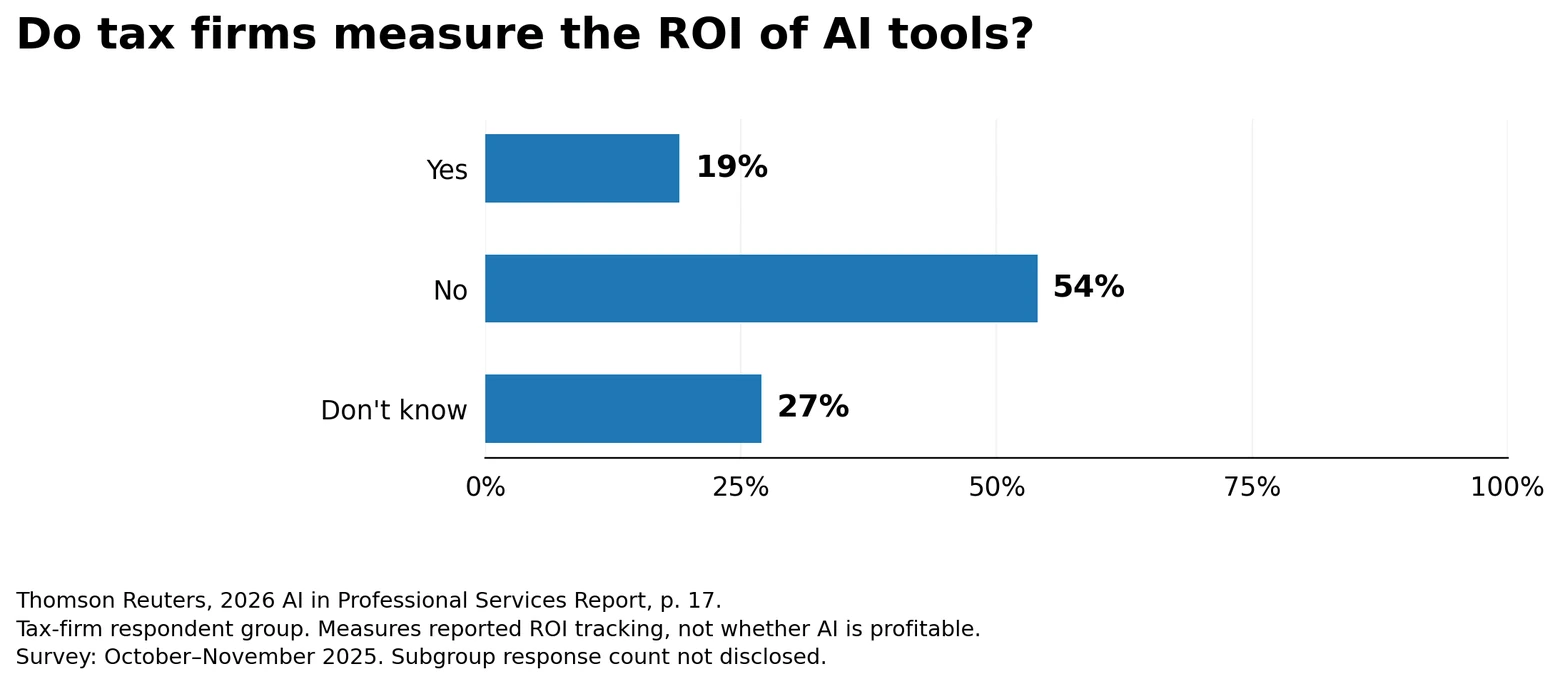
Figure 3. Reported ROI measurement among tax-firm respondents. The question concerns whether ROI is measured, while profitability falls outside its scope. Source: Thomson Reuters, 2026 AI in Professional Services Report, p. 17; tax-firm respondent group. [3]
A sound internal ROI calculation includes review, corrections, failed runs, implementation, software costs, and training. Time released for other work creates capacity. It becomes cash savings or additional revenue when the firm changes spending or delivers additional paid work.
How much human oversight do accountants want?
The Intuit results favor assistance and review over unrestricted execution for client deliverables.
They describe the role respondents would ideally assign to AI, separate from the configuration already running in their firms. [1]
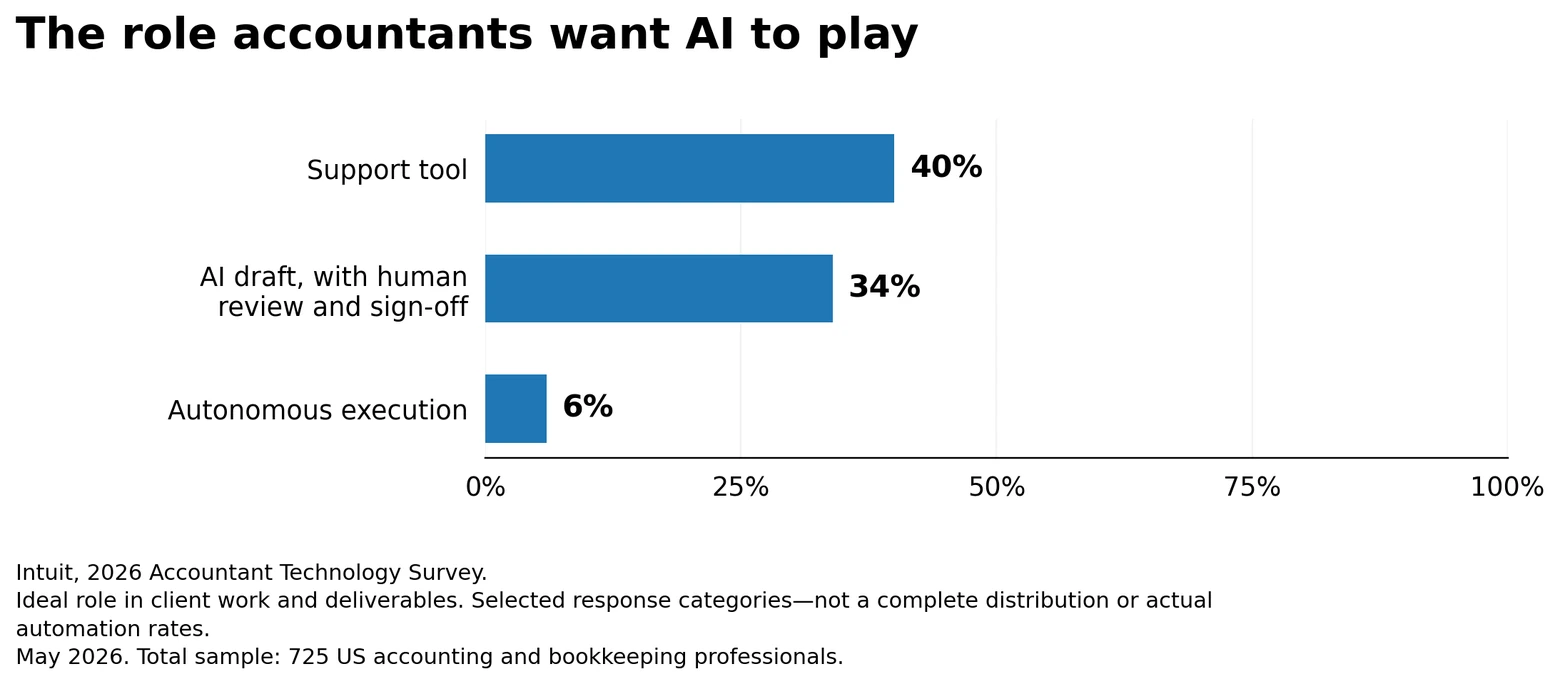
Figure 4. Selected response categories from Intuit's May 2026 survey of 725 US accounting/bookkeeping professionals. The categories form a partial distribution and concern preferred oversight; actual automation falls outside the question. [1]
The survey also leaves open how respondents outside the autonomous-execution category review individual items. A preference question cannot answer that operational question.
Wanting oversight is not the same as implementing it
The FRC's corporate-reporting summary reports that 44% of companies had mandated human oversight. This records a formal control in the research population. The prevalence of review among the remaining companies and the effectiveness of each mandate fall outside the finding. [4]
The same research reports enterprise-tool use among 91% of GenAI-using respondents and public-tool use among 24%. Those groups overlap. Public-tool use raises questions about tool approval and data-handling rules, while breach incidence falls outside the measure. [4]
What does meaningful oversight involve?
FRC guidance treats human involvement as directing, authorizing, or reviewing actions and outputs, including designated control points. Its intended audience is audit-firm technical teams, and its scope does not create a universal bookkeeping law. [7]
IESBA's technology materials emphasize professional responsibility, confidentiality, appropriate reliance on outputs, and the danger of automation bias: accepting a system's answer despite reasons to question it. Its July 2026 staff publication is supporting guidance, separate from a new standalone auditing standard. [8] [10]
An oversight design should allow a qualified person to challenge the result. The table below is this article's operational synthesis of those principles and carries no claim of regulatory prescription or proof of compliance.
Control point | The question a reviewer should be able to answer | Useful evidence to retain |
|---|---|---|
Input | Was the source complete, relevant, and authorized? | Source record, document, period, and access context |
Recommendation | What supports the suggested treatment? | Relevant history, rules, retrieved evidence, and unresolved uncertainty |
Authorization | Was the action within the approved workflow? | Permissions, approval status, restrictions, and escalation decision |
Execution | What actually changed, and what failed? | Applied result, rejected items, and partial-completion status |
Review | Who accepted, corrected, or rejected the result? | Reviewer decision, reason, and correction history |
Reviewing a conclusion and merely acknowledging that a system produced one are different controls. A confidence score or an “approved” status cannot replace evidence supporting the accounting outcome.
Are smaller accounting practices ready for AI?
Regular use and access to employer-provided AI learning vary across accounting-practice categories.
ACCA's training data illustrates the gap across the same practice categories used in Figure 1. [2]
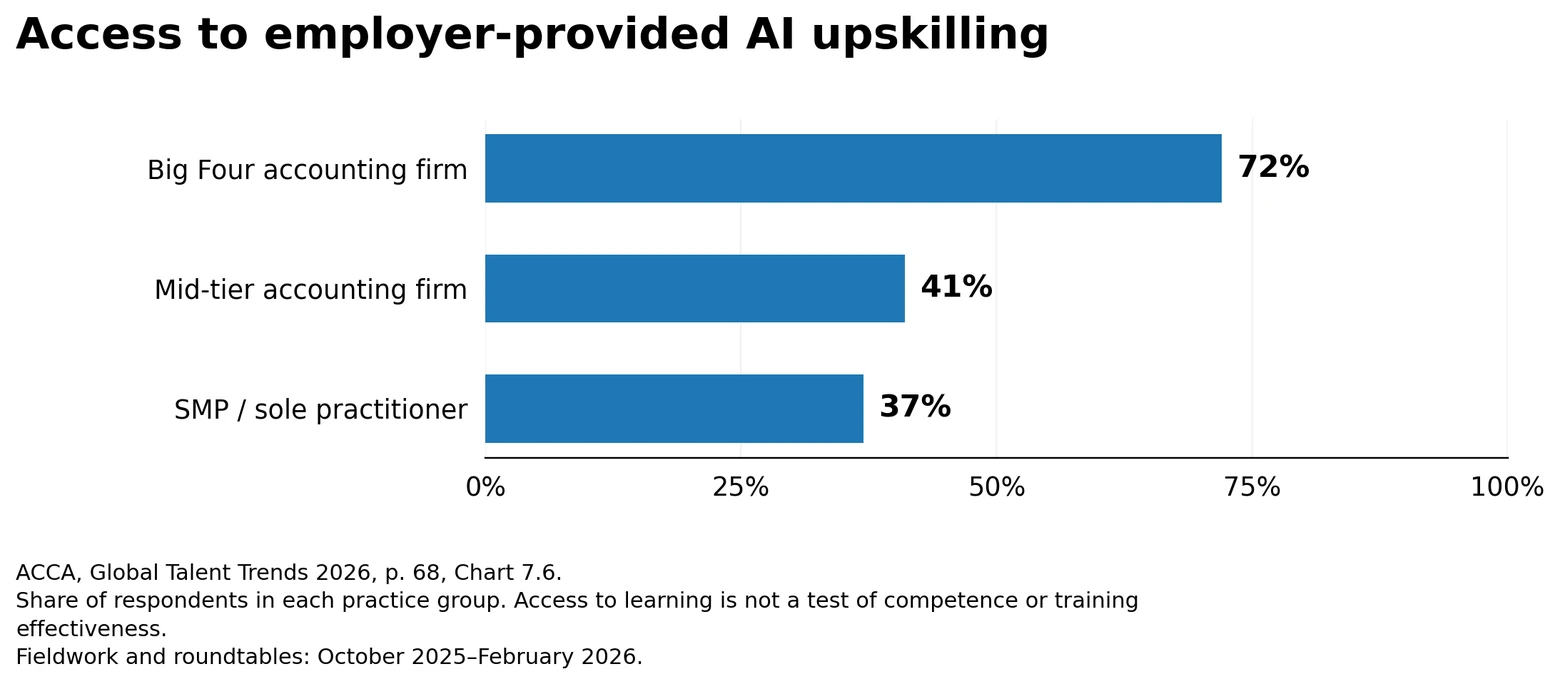
Figure 5. Employer-provided AI upskilling opportunities reported by accounting-practice respondents. Source: ACCA, Global Talent Trends 2026, p. 68, Chart 7.6. The measure covers access; course completion, competence, and effectiveness require separate evidence. [2]
Across ACCA's wider sample, 82% felt confident learning and applying AI skills, while 43% reported employer-provided upskilling opportunities. These measure self-confidence and access respectively. Proficiency requires separate testing. [2]
A separate historical readiness benchmark comes from CIMA's December 2025 release. Among 1,446 senior finance and accounting leaders and managers, 8% considered their organization very well prepared for AI and 21% well prepared. The accessible release omits fieldwork dates, which prevents labeling these figures a 2026 survey. [9]
For a smaller practice, one sound starting point is a repeatable workflow with a defined review boundary. The firm can then measure whether the system reduces total work without increasing correction risk. Training should cover how to reject unsupported output as well as how to obtain it. Bank reconciliation fits that description: the matching itself is mechanical, and the items that do not match are the ones that need a person.
What should an accounting firm measure before expanding automation?
Measure the completed workflow, including the human work that remains.
The following framework is proposed for internal measurement and is separate from published industry benchmarks.
Metric | Suggested definition | Why it is useful |
|---|---|---|
End-to-end touchless rate | Items reaching the defined endpoint with no human intervention ÷ all items in the same intake cohort | Separates full workflow completion from an automated first step |
Human handling time | Total active human minutes, including review and corrections, for a defined cohort | Avoids claiming savings while shifting effort into cleanup |
Exception rate | Unique items requiring exception handling ÷ all items in the same cohort | Reveals where the workflow needs attention; an exception is not necessarily an error |
Validated correctness | Correct outcomes in an independently checked sample ÷ reviewed sample items | Tests quality against evidence rather than acceptance alone |
Correction rate | Completed items subsequently corrected within a defined follow-up window ÷ completed items with that window observed | Captures downstream rework that an initial success status misses |
Cycle time | Elapsed time from a specified starting event to a specified completed endpoint | Distinguishes waiting time from active processing |
These definitions require a stable scope. A bank-feed categorization workflow and a complete monthly close have different endpoints. A ratio calculated only on “eligible” items should disclose the eligibility rules and the proportion of the original workload excluded.
Use matched periods and comparable client files when assessing change. Keep the same definition of an exception before and after deployment. Excluding difficult cases can create apparent improvement without improving how those cases are handled.
“The document was extracted” and “the entry was applied in the accounting system,” for example, should be separate completion events. This separation helps identify whether a delay came from missing documents, an uncertain suggestion, review, or execution.
What do these statistics not tell us?
The studies support conclusions only within the populations, tasks, and controls they measured:
Adoption percentages remain tied to their original populations and questions. Pooling them because they all mention AI would produce an unsupported industry average.
Reports from different years may change the question, sample, and meaning of adoption. A continuous historical curve requires comparable observations.
A reduced share of time spent on data entry describes task allocation. The finding leaves open whether a firm reduces headcount, grows its client base, or reallocates capacity. [6]
The cited studies examine external industry evidence. They supply no Booke-specific accuracy, automation coverage, time savings, security, or ROI results.
Self-reported benefits, confidence, investment plans, and preferences document what respondents say. Measured outcomes and causal conclusions require additional evidence.
Frequently asked questions
What is the best AI adoption statistic to cite for accounting?
Choose the measure that matches the claim. Intuit is useful for reported US practitioner use; ACCA for international individual use and practice segments; Thomson Reuters for tax-firm organizational GenAI adoption; and FRC/Lancaster for UK corporate reporting. Preserve the original population and definition. [1] [2] [3] [4]
Is AI replacing accountants?
The evidence provides no accounting-wide job-replacement rate. Choi and Xie's study supports a more specific discussion of task mix, accuracy, and human–AI interaction in its sample. That sample cannot support forecasts that the profession disappears or that every job remains unchanged. [6]
Does human-in-the-loop mean manually approving every transaction?
No. FRC guidance includes direction, authorization, and review at control points. The appropriate design depends on the task and applicable professional requirements. Universal manual checking and unrestricted automation are both broader than the guidance supports. [7]
Does a high AI confidence score prove that an entry is correct?
No. A score and an independently verified accounting outcome are different measurements. The relevant questions are whether evidence supports the treatment and whether the score has been validated for that use. Professional responsibility remains with the accountant. [8]
Are all the figures in this article from 2026?
No. The year identifies this edition's evidence review. Observation periods are retained: Thomson Reuters' 2026 report uses October–November 2025 fieldwork, and KPMG's historical example uses February–March 2024 data. [3] [5]
Bottom line: measure work, evidence, and accountability
The evidence directs the conversation beyond whether accountants are “using AI.” Firms need to examine the work AI performs, the evidence behind its output, the effort left to people, and the authority to act.
A strong evaluation asks whether a defined workflow produces reliable completed work, exposes uncertainty, and leaves an accountable person able to intervene. The same discipline applies when citing research: keep the population, question, period, and limitation attached to the number.
Methodology, disclosure, and source notes
How this article was researched
This is a scoped synthesis of English-language research, with sources checked on September 13, 2026. Its scope excludes a systematic review, an original survey, and an independent replication of the studies.
Selection favored original reports, official research summaries, a final peer-reviewed accounting paper, and professional guidance. Survey responses, observed associations, experimental results, and normative guidance are identified separately. Conflicting or insufficiently defined claims were excluded instead of being resolved by choosing the most striking number.
Most adoption figures are self-reported. Intuit, Thomson Reuters, and KPMG have commercial interests in the technology or services discussed, which warrants close attention to their sampling and definitions. Sample size alone cannot remove selection bias. Missing subgroup counts and uncertainty estimates have not been reconstructed from rounded percentages.
The charts are original visualizations of published aggregate figures. The publishers' graphics were not copied, and the source populations remain separate. Accessible data tables accompany each chart in the HTML edition.
Publisher disclosure and related workflow context
Booke AI develops bookkeeping automation software. This article synthesizes external research and provides no independent review of Booke or evidence of Booke-specific performance.
For product context, see the Booke AI bookkeeping overview and the explanation of bookkeeping automation workflows. Those pages describe Booke's offering; the external sources below support the industry findings.
Sources
[1] Intuit: 2026 Accountant Technology Survey. Published June 23, 2026; online fieldwork in May 2026. US accounting/bookkeeping respondents recruited through Prodege pools and partner networks, with remuneration. Official results and methodology checked. Read the original results.
[2] ACCA: Global Talent Trends 2026. Fieldwork and roundtables: October 2025–February 2026. Relevant material: methodology p. 4; regular use and agents pp. 65–66; upskilling p. 68. Official PDF and relevant charts checked. The cited charts omit practice-group counts. Read the report.
[3] Thomson Reuters Institute: 2026 AI in Professional Services Report. Fieldwork: October–November 2025. Recruited from publisher-provided lists with AI-familiarity screening and quotas. Relevant pages: organizational adoption p. 5; use cases p. 8; agents p. 9; ROI p. 17; methodology p. 23. Official PDF charts checked. Read the report.
[4] Financial Reporting Council / Lancaster University: The use of Artificial Intelligence Technologies in Corporate Reporting. Survey: February 17–April 21, 2026. Official FRC results and methodological background checked; the separate linked survey-results file remained unavailable during this review. Numerical claims here use the FRC's own published summary. Read the research summary.
[5] KPMG: AI in financial reporting and audit: Navigating the new era. Historical context, 2024. Fieldwork: February–March 2024; senior financial-reporting executives and board members, corporate rather than small-practice population. Methodology p. 6; adoption discussion pp. 8–9. Official PDF checked. Read the report.
[6] Jung Ho Choi and Chloe L. Xie: Human + AI in Accounting: Early Evidence from the Field. Journal of Accounting Research, 64(3), 1333–1373, 2026. DOI: 10.1111/1475-679x.70052. Survey waves: November 2024 and March 2025; platform records: January 2023–March 2025; experiment: June–July 2025. Final publisher-supplied text available on ResearchGate was checked; direct publisher access was restricted. See section 4.5/Table 10 for the experiment. Journal record · Full-text access used for verification.
[7] Financial Reporting Council: Generative and Agentic AI Guidance. March 2026. Guidance for audit-firm central technical teams; definitions p. 4. Its scope is professional control guidance; adoption measurement and universal bookkeeping requirements fall outside it. Official PDF checked. Read the guidance.
[8] IESBA: Snapshot: Ethics and Independence Approach to the Use of Technology. June 11, 2026. Official explanatory material on professional competence, reliance on technology, automation bias, confidentiality, and accountability. It is separate from the full Code and from a new standalone standard. Read the snapshot.
[9] CIMA: Future-ready Finance: Technology, Productivity, and Skills Survey, official release. December 17, 2025. Historical readiness context. The full report and fieldwork dates remained unverified; this article uses only consistent readiness findings in the official release. Read the release.
[10] IESBA staff: Emerging Technologies: A Characteristics-Based Approach to Ethical Considerations for Professional Accountants. July 15, 2026. Official publication announcement checked for scope and responsibility principles. The material is supporting, non-authoritative guidance, and the Code remains in force. Read the announcement.
Citation and update note
When quoting a statistic, cite the original research and retain its population and period. When referencing this article's comparison or original charts, credit Booke AI as the compiler and visualizer, alongside the underlying source. No claim of ownership is made over the publishers' findings or reports.
September 13, 2026: initial evidence edition prepared. Future revisions should record material changes in definitions, source versions, or included findings; simply replacing the year in the title is insufficient.