Bank reconciliation: what it is, how to do it, and a worked example
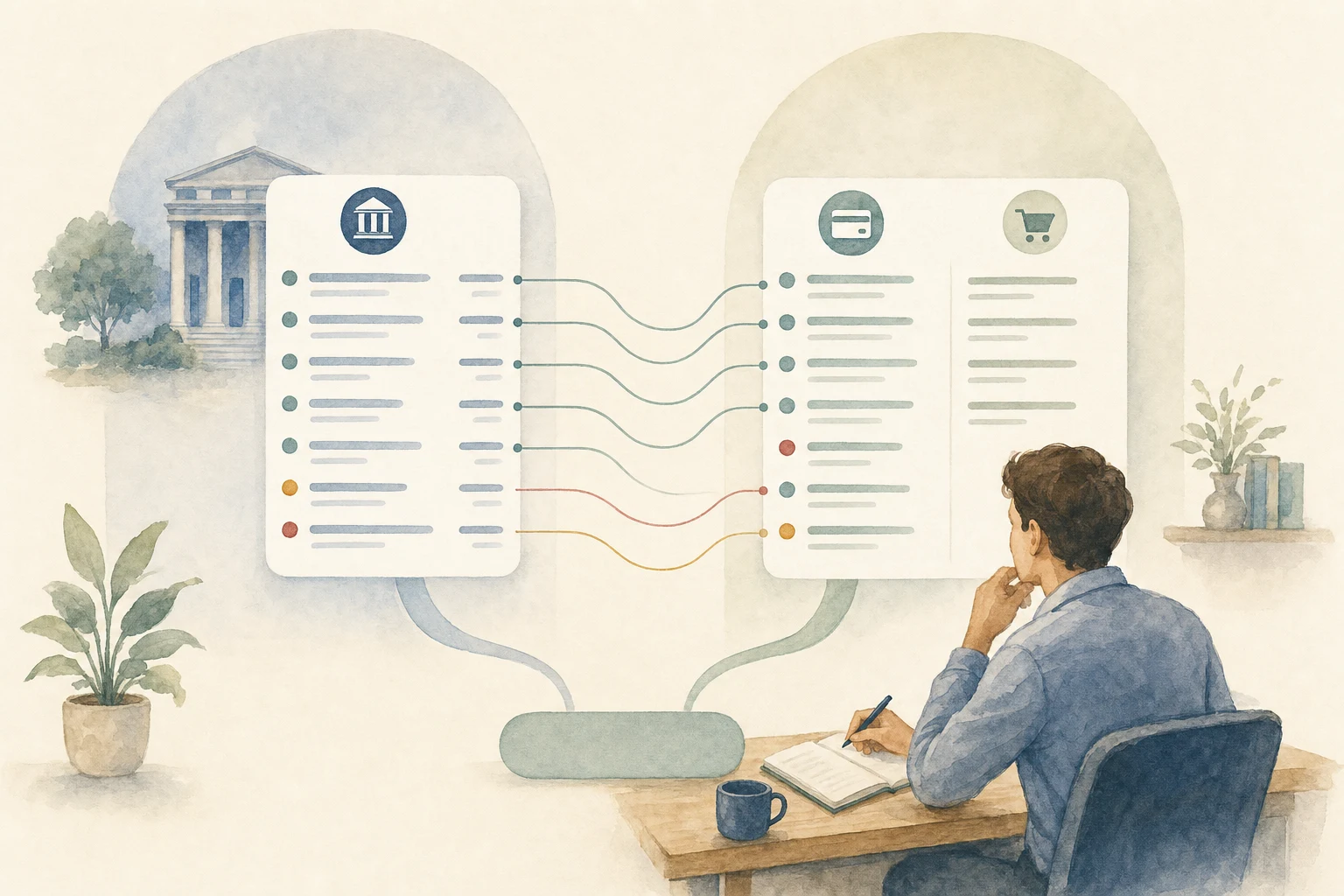
A bank reconciliation compares the cash balance in your accounting records against the balance on the bank statement for the same period, explains every difference between the two, and records the items that belong in the books.
The two numbers almost never match on the first look, and that is normal. A check you wrote three weeks ago may still be uncashed. A deposit made on the last day of the month may clear on the first day of the next one. The bank may have taken a fee you have not entered yet. Reconciliation is the work of naming each of those gaps and deciding which side has to change.
What a bank reconciliation is
The bank keeps its own record of your account. You keep yours. Both are records of the same cash, written by different parties at different moments, so they drift apart during the month and come back together once the timing differences clear.
A reconciliation is finished when you can account for the full difference between the two balances, line by line, and the adjusted figures agree. It is not finished when the difference is small. A $12 gap you cannot explain is a reconciliation that has not been done, and small gaps are often two larger errors pointing in opposite directions.
The output is usually a bank reconciliation statement: a short schedule showing the bank balance, the book balance, the adjustments to each, and the single figure both sides arrive at.
The bank reconciliation formula
Two half-formulas, one result.
On the bank side:
Bank statement balance + deposits in transit − outstanding checks ± bank errors = adjusted bank balance
On the book side:
Ledger balance + amounts collected by the bank − bank charges and fees − returned (NSF) items ± recording errors = adjusted book balance
The reconciliation holds when the two adjusted balances are equal.
The asymmetry between the two lists matters. Items on the bank side are timing differences: you already recorded them, the bank has not processed them yet, and they will clear on their own. Items on the book side are things you did not know about when you made your entries, so they need journal entries. Nothing on the bank side gets a journal entry. That single rule prevents most double-counting.
What makes the two balances differ
Deposits in transit: money you received and recorded, banked late in the period, still not credited on the statement.
Outstanding checks: payments you issued and recorded that the payee has not presented yet. These often run for weeks, and a check that has been outstanding for six months usually needs investigating rather than carrying forward again.
Bank service charges: account fees, wire fees, card processing costs. You learn the amount from the statement, so the entry comes after.
Interest credited: small on a current account, but it still has to be recorded.
Returned deposits: a customer check that bounced. The bank reverses the credit and often adds a fee. The receivable comes back.
Direct debits and standing orders you have not entered: insurance, subscriptions, loan payments that leave the account on a schedule.
Recording errors: transposed digits are the classic case. A payment of $425 entered as $452 leaves a $27 gap, and any difference divisible by nine is worth checking for transposition before anything else.
Bank errors: rare, and they do happen. If the bank made the mistake, the correction belongs on the bank side of the schedule and you raise it with them. You do not adjust your books for someone else's error.
How to do a bank reconciliation, step by step
1. Fix the period and collect the documents. You need the bank statement for the period, the cash account from your ledger for the same dates, and the previous reconciliation. Mismatched date ranges are the most common reason a reconciliation refuses to balance.
2. Start from the previous closing figures. Last period's outstanding checks and deposits in transit are this period's opening items. Anything on that list that still has not cleared stays on it and gets older.
3. Tick off the deposits. Compare every credit on the statement against receipts in the ledger. Whatever is in your books but not on the statement becomes a deposit in transit. Whatever is on the statement but not in your books needs identifying before you go further.
4. Tick off the payments. Same pass in the other direction. Unpresented checks and card payments that have not settled become outstanding items.
5. List what only the bank knew. Fees, interest, returned items, direct debits. These are the entries you were not in a position to make earlier, and each one needs a journal entry now.
6. Build both columns. Adjust the bank balance for timing, adjust the book balance for the new information, and compare the two results.
7. Find the remainder, then post. If a difference is left, work it before recording anything. Once the columns agree, post the book-side adjustments and file the schedule with the statement.
Some guides describe this as four steps, others as eight. The count depends on how finely the middle is split. The sequence is the same.
A worked example
A small firm closes February. The statement shows $12,480.00. The cash account shows $11,905.00. The gap is $575.00.
Bank side
Balance per bank statement, 28 February: $12,480.00
Add: deposit in transit, 27 February: $1,400.00
Add: deposit in transit, 28 February: $750.00
Less: check 1041, outstanding: ($1,280.00)
Less: check 1044, outstanding: ($890.00)
Less: check 1047, outstanding: ($1,250.00)
Adjusted bank balance: $11,210.00
Book side
Balance per cash account, 28 February: $11,905.00
Add: interest credited by the bank: $15.00
Less: account service charge: ($35.00)
Less: customer check returned unpaid: ($650.00)
Less: check 1039 recorded as $400, written for $425: ($25.00)
Adjusted book balance: $11,210.00
Both columns land on $11,210.00, so February reconciles.
Four journal entries follow, one for each book-side line. The interest is income. The service charge is an expense. The returned check puts $650.00 back into accounts receivable and the customer owes it again. The $25.00 corrects an entry that was wrong from the day it was made.
The three outstanding checks and the two deposits in transit get no entries at all. They were recorded correctly and are simply waiting for the bank. They carry forward and become the opening items for March.
Where the difference usually hides
Work the cheap checks first.
Divide the unexplained amount by nine. A whole number points at transposed digits, and you can usually find the entry by scanning for that digit pattern rather than re-checking everything.
Halve it. If the result matches a real transaction, the amount was probably entered on the wrong side, and a debit posted as a credit creates a gap of exactly twice the amount.
Look for the figure itself. Search the ledger and the statement for the exact number before assuming several errors combined into it. One item explains most single differences.
Check the dates at both ends of the period. A transaction sitting one day outside the range accounts for a surprising share of reconciliations that will not close.
Compare the opening balance against last period's closing balance. If those disagree, the problem is older than the period you are working on, and nothing you do inside this month will fix it.
How often to reconcile
Monthly is the common rhythm because it matches the statement cycle, and for a low-volume account it is enough.
Accounts with daily card settlements, payment processor payouts or a high check volume drift faster than that. Weekly or even daily review keeps the list of unexplained items short, and a short list is what makes month-end quick. The work is the same either way. Doing it more often mostly changes how much of it piles up.
Reconciling every bank and credit card account matters more than reconciling any one of them frequently. An unreconciled card account hides the same problems as an unreconciled current account.
Where software helps, and where it does not
Accounting platforms import the bank feed, suggest matches between feed lines and existing records, and let you set rules so that recurring payments are coded the same way each time. That removes most of the mechanical comparison in steps three and four.
Automation prepares the work. It does not decide that an account is reconciled. A suggested match is a proposal with a confidence level attached, and the platform stays the system of record. Someone has to look at the exceptions, at anything unusual, and at the final figure. How much of that review accountants say they want, and how much their firms implement, is collected in our AI in accounting statistics review.
This is the line worth holding when you evaluate tools. Software that categorizes bank-feed transactions, attaches the supporting document and routes what it cannot resolve is doing preparation, and preparation is most of the clock time. The judgment at the end stays with a person. What the AI built into QuickBooks Online and Xero does at each step is covered in AI bank reconciliation in QuickBooks Online and Xero.
Booke AI works inside bank feeds already connected to QuickBooks Online or Xero: it categorizes eligible transactions, matches them to supporting records, and leaves low-confidence cases for you or your bookkeeper. Your accounting platform remains the ledger, and reconciliation preparation does not mean every account closes without review.
Frequently asked questions
What is meant by bank reconciliation?
Comparing the cash balance in your own records with the balance the bank reports for the same period, explaining every difference, and recording the items that belong in your books.
What is the formula for a bank reconciliation?
Bank statement balance plus deposits in transit minus outstanding checks, set against ledger balance plus bank collections minus charges, returned items and recording errors. The reconciliation holds when both adjusted figures are equal.
What are the steps in a bank reconciliation?
Fix the period and gather documents, carry forward last period's uncleared items, match deposits, match payments, list the items only the bank knew about, build both adjusted columns, then investigate any remainder before posting.
How do I prepare a bank reconciliation statement?
Write it as two short schedules, bank side and book side, each starting from its own balance and ending at the same adjusted figure. Keep it with the statement it relates to.
Which side gets the journal entries?
Only the book side. Bank-side items are timing differences that clear by themselves. Posting entries for them double-counts the cash.
What if the difference will not go away?
Check it for transposition, check whether it is exactly twice a real transaction, search both records for the figure itself, and verify that the opening balance agrees with last period's close. If it survives all four, the error predates this period.
How long should an outstanding check stay on the list?
Until it clears or until it is clearly stale. Checks outstanding beyond a few months usually need contacting the payee and, depending on local rules, either reissuing or writing back.
Sources