Business expense categories: a small business list mapped to Schedule C

Business expense categories are the labels a business uses to group what it spends, such as rent, advertising, supplies and travel. For a sole proprietor or single-member LLC, the most practical set of categories is the list of expense lines on IRS Schedule C, because every category in the books eventually has to land on one of those lines.
Because of that link, a miscoded transaction is cheaper to fix in the month it arrives than in April. If each category maps to one tax line, the year-end numbers come straight out of a report. Categories that mix lines, or hide something that is not deductible, have to be untangled before the return can be prepared.
This guide lists the expense categories for small businesses that cover most day-to-day spending, the 2025 Schedule C line each one feeds, the purchases that should not be expensed at all, and a worked example of one week of bank-feed lines.
What counts as a business expense
The IRS test comes from Publication 334. An expense is deductible when it is ordinary and necessary. Ordinary means common and accepted in your field of business. Necessary means helpful and appropriate for the business, and it does not have to be indispensable.
Two limits sit next to that test.
Personal spending is not a business expense, even when it is paid from a business account. When a cost is partly business and partly personal, such as a phone plan or a car, the personal share has to be separated out, and that share is generally not deductible.
Some business spending is not deducted in the year it is paid. Equipment, furniture and most purchased software are capital costs. They are recovered through depreciation over several years, or deducted early through section 179 or the de minimis safe harbor covered below.
That leaves three groups of outflows in a business account. Operating expenses are deducted as they occur. Capital purchases go through depreciation or a safe harbor. Owner's draws, transfers and loan principal are not expenses at all, and they need their own place in the books so they do not quietly inflate costs.
Business expense categories list, with Schedule C lines
The list below follows Part II of the 2025 Schedule C. Line numbers match the form, so a bookkeeper can map a chart of accounts to them directly. Partnerships and corporations report expenses on other returns with different line names, but the same groupings carry over.
Premises
Rent or lease of other business property (line 20b): office space, a shop or a warehouse.
Rent or lease of vehicles, machinery and equipment (line 20a): the business portion of what you pay to rent or lease them.
Utilities (line 25): electricity, gas, water and business phone service. If a home phone is used for business, the base rate of the first line into the residence is not deductible. A second line used for business is.
Repairs and maintenance (line 21): incidental repairs that do not add to a property's value or noticeably extend its life. Restoring or replacing property is a capital cost.
Business use of your home (line 30): figured on Form 8829 or with the simplified method, and reported only on line 30.
People
Wages (line 26): salaries and wages paid to employees, reduced by certain employment credits.
Contract labor (line 11): payments to people you do not treat as employees, such as independent contractors.
Commissions and fees (line 10): commissions and fees paid during the year that are not capitalized or deducted on another line.
Employee benefit programs (line 14): accident and health plans, group-term life insurance and dependent care assistance for employees.
Pension and profit-sharing plans (line 19): employer contributions to plans for employees. Contributions made on your own behalf as a self-employed person go on Schedule 1 of Form 1040.
Selling and marketing
Advertising (line 8): paid ads, sponsorships and promotional material.
Office and administration
Office expense (line 18): office supplies and postage.
Supplies (line 22): materials and supplies used in the business that are not part of cost of goods sold, generally deducted as they are used up.
Legal and professional services (line 17): fees charged by accountants and attorneys, including tax advice for the business and preparation of its tax forms.
Insurance (line 15): premiums for business insurance. Employee accident and health insurance belongs on line 14.
Taxes and licenses (line 23): licenses and regulatory fees, taxes on business property, the employer's share of social security and Medicare, and federal unemployment tax. Federal income tax and self-employment tax do not go here.
Software subscriptions (other expenses, line 48): subscription services and tools used to run the business. Purchased software is a different case: most of it has to be capitalized and depreciated, or expensed under section 179.
Bank and merchant fees (usually other expenses, line 48): account fees, wire fees and card processing fees.
Vehicles, travel and meals
Car and truck expenses (line 9): either the actual cost of operating the vehicle or the standard mileage rate, for the business share of its use.
Travel (line 24a): lodging and transportation for overnight business travel away from your tax home.
Deductible meals (line 24b): business meals, generally at 50% of the cost. Entertainment does not belong on this line.
Financing
Mortgage interest (line 16a): interest paid to banks and other lenders on mortgages for business property.
Other interest (line 16b): interest on business loans and other business debt. Only the interest belongs here. The principal part of a loan payment reduces the loan balance.
Assets and startup costs
Depreciation and section 179 (line 13): the annual deduction for property with a useful life well beyond the year, such as equipment, furniture and vehicles.
De minimis purchases (other expenses, line 48): tangible items under the safe harbor threshold, if the business elects it.
Business startup costs (other expenses, line 48): in the year the business begins, up to $5,000 can be deducted, reduced by the amount by which total startup costs exceed $50,000. The rest is amortized over 180 months.
Everything else
Cost of goods sold (Part III): inventory, raw materials and other direct costs of the products you sell. These costs reduce gross profit, and the operating expense lines are counted after them.
Other expenses (line 27b, itemized on line 48): ordinary and necessary costs that fit no line above. The IRS asks for each type to be listed separately, and it excludes equipment, improvements, personal expenses, charitable contributions and government fines from this line.
The $2,500 rule for equipment and other purchases
Generally, a business has to capitalize what it pays to acquire equipment, furniture and other tangible property, and recover that cost through depreciation. The de minimis safe harbor is an exception to that rule, and it is what people usually mean by the $2,500 expense rule.
A business that elects the safe harbor can deduct amounts paid for tangible property up to $2,500 per item or invoice. A business with an applicable financial statement, such as an audited one, can use a $5,000 limit instead.
Three conditions matter in practice:
The same amounts have to be expensed in the business's books as well as on the tax return.
The election is made each year, by attaching a statement to the return filed on time, including extensions. Chapter 8 of Publication 334 has the details.
Amounts deducted this way go on line 48 as other expenses.
A $1,800 laptop bought on its own invoice can be expensed under the safe harbor. A $3,200 laptop cannot, so it goes through depreciation or section 179.
For a bookkeeper, the practical consequence is a written capitalization policy. Apply the threshold to every purchase and keep the invoices, because the limit is tested against them.
Where categorization usually goes wrong
Each item below either puts a cost on the wrong tax line or counts something that is not an expense.
Entertainment coded as meals. Client dinners and event tickets land in one account, but only the meal can be deductible, usually at 50%. Tickets to a game are entertainment, and IRS Publication 463 says entertainment expenses are not deductible. A separate entertainment account keeps the two apart.
Loan payments coded as expenses. A monthly loan payment contains interest and principal. Only the interest is an expense. Booking the whole payment overstates expenses and leaves the loan balance wrong.
Transfers and card payments coded as expenses. Moving money to savings, or paying the business credit card, is not spending. The card purchases were already recorded when the card transactions came in, so coding the payment as an expense counts them twice.
Owner's personal charges left in expenses. A streaming subscription paid with the business card is an owner's draw.
Income tax payments coded as taxes and licenses. Federal income tax and self-employment tax are paid by the owner, often from the business account, but the Schedule C instructions exclude them from line 23.
Charitable contributions in operating expenses. Several popular expense lists include donations as a business category, but the Schedule C instructions say not to include charitable contributions among business expenses.
Purchased software coded as a subscription. A monthly plan is an operating cost. A license bought outright is usually a capital cost.
Fines and penalties deducted. Penalties paid to a government for violating a law are not deductible, even when they arise in the course of business.
Worked example: one week of bank-feed lines
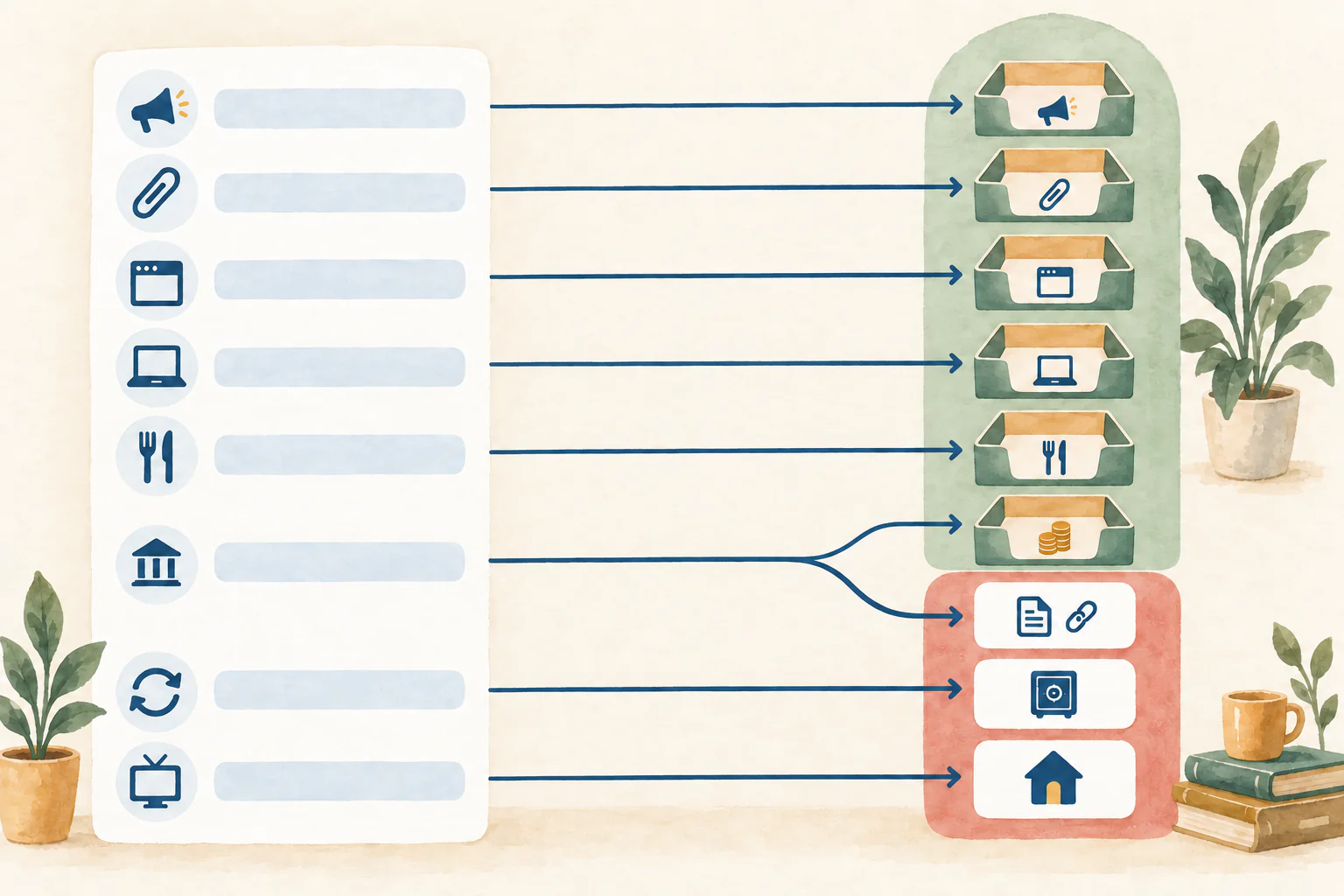
Eight lines from a small design agency's business account, categorized with the list above:
Online ads platform, $412.50: Advertising (line 8).
Office supply store, $146.20 for paper, toner and stamps: Office expense (line 18).
Design software, monthly plan, $59.99: Other expenses, software subscription (line 48).
Laptop for a new designer, $1,849.00 on its own invoice: expensed under the de minimis safe harbor if the business elected it (line 48). Without the election, it is depreciated (line 13).
Lunch with a client to review a proposal, $96.40: Deductible meals (line 24b). The deductible amount is generally $48.20. Note who attended and the business purpose.
Bank loan payment, $1,200.00, of which $150.00 is interest: split the line. $150.00 goes to other interest (line 16b), and $1,050.00 reduces the loan balance.
Transfer to the business savings account, $2,000.00: not an expense. The money moves between two of the business's own accounts.
Streaming subscription on the business card, $15.49: owner's draw.
Of the $5,779.58 that left the account that week, $2,714.09 is business expense. The remaining $3,065.49 is loan principal, a transfer and a personal charge, and none of it belongs in the expense accounts.
Three of the eight lines are not expenses at all, and a fourth has to be split before it can be coded. Coding by vendor name alone would have put all eight into expense accounts.
Setting up expense categories in your chart of accounts
Expense categories live in the expense section of the chart of accounts.
Start from the tax lines. With one account per Schedule C line, the year-end mapping is already done.
Add sub-accounts only when someone will use the split. Separating software subscriptions from other expenses is useful when the owner wants to watch that spending. A separate account for each vendor is not.
Name accounts for what they contain rather than who was paid. "Advertising" survives a change of ad platform; an account named after one platform has to be renamed or abandoned.
Give the non-expenses a home. Owner's draws, loan principal and transfers need their own equity, liability and clearing accounts, or they drift into "Other expenses".
In QuickBooks Online, the software suggests a category for each downloaded bank transaction based on how similar transactions were categorized before, and bank rules can categorize recurring transactions automatically. Both repeat earlier decisions, so a transaction coded wrongly once tends to be coded wrongly again until someone corrects it.
Keeping categorization consistent across clients
For a firm that codes transactions for many small businesses, the list is the easy part. Consistency is harder: the same vendor coded two ways in two months, a new vendor that no rule covers, a charge that only makes sense once the client explains it.
Bank rules handle the predictable part. The rest is where review time goes, and it is what automatic transaction categorization in Booke AI is designed for. It works in bank feeds already connected to QuickBooks Online, learns each client's categorization history, takes the client's comments into account, and routes uncertain transactions to a person for review. The wider workflow, including document matching and reconciliation preparation, is covered on the bookkeeping automation software page.
Month-end catches some of what slips through. A bank reconciliation compares amounts, so a correct amount in the wrong category passes it. Reconciling the credit card account catches the double counting from mistake 3: a card payment coded as an expense leaves the card balance too high, so the account stops agreeing with its statement.
Frequently asked questions
What are the IRS expense categories?
For sole proprietors and single-member LLCs, they are the expense lines in Part II of Schedule C: advertising, car and truck expenses, commissions and fees, contract labor, depletion, depreciation and section 179, employee benefit programs, insurance, mortgage and other interest, legal and professional services, office expense, pension and profit-sharing plans, rent or lease, repairs and maintenance, supplies, taxes and licenses, travel, deductible meals, utilities, wages, the energy efficient commercial buildings deduction and other expenses. Business use of the home is reported separately on line 30.
What is the $2,500 expense rule?
It is the de minimis safe harbor for tangible property. A business that elects it can deduct purchases up to $2,500 per item or invoice instead of depreciating them, or up to $5,000 if it has an applicable financial statement. The same amounts must be expensed in the books, and the deduction is reported as other expenses.
How do I categorize business expenses?
Set up expense accounts that match your tax return lines, and give non-expenses such as transfers, loan principal and owner's draws their own accounts. Then assign every bank and card transaction to one of them as it arrives, split mixed payments like loan installments, and keep receipts for anything the bank description does not explain.
Are business meals and entertainment deductible?
Business meals are generally deductible at 50% when they meet the IRS conditions: the expense is ordinary and necessary, not lavish, and you or an employee is present with a business contact, or the meal is taken while traveling for business. Entertainment, such as event tickets, is not deductible, and the Schedule C instructions say not to report it on the meals line.
How long should I keep receipts and records?
Generally for three years from the date the return was filed, which is the usual period in which the IRS can assess additional tax. Some cases need longer, such as seven years when you claim a loss from worthless securities or a bad debt deduction. Records for property should be kept until the period of limitations expires for the year you dispose of the property.
Scope of this guide
This guide describes federal rules for sole proprietors and single-member LLCs that file Schedule C, based on the 2025 form and instructions. Partnerships and corporations report expenses on other returns, and state rules can differ. For a specific transaction, confirm the treatment with the business's tax preparer.
Sources