Owner contribution, loan or owner's draw: what AI did with an owner's $5,000

An owner contribution is money you put into your business and leave there, so it goes to an equity account, your stake in the business. A loan from the owner is money the business will pay back to you, so it's a liability. An owner's draw is money you take out for yourself; it reduces equity and isn't an expense¹. Your bank feed shows all three as plain transfers.
We ran Ethan Bloch's ChatGPT audit prompt² 12 times across three AI models, on a test September for a small candle shop with 7 categories set wrong on purpose. Every run moved the owner's $5,000 from Sales to Owner Contribution. In the 6 runs without an owner note, none asked whether it was a loan. One sentence in your notes settles it, and it's below, ready to copy.
We build Booke AI, AI bookkeeping software for QuickBooks Online and Xero.
Where each kind of owner money goes in QuickBooks Online and Xero
Owner contribution
In QuickBooks Online, Intuit sets up the equity account with the Equity type and the Owner's Equity detail type³, and you categorize the deposit to it⁴. In Xero, it's funds introduced⁵.
Loan from the owner
Intuit's general loan setup for QuickBooks Online puts a loan repaid within the year under Other Current Liabilities and a longer one under Long Term Liabilities; only the interest the business pays on it is an expense⁶. Xero's loan article sets it up as a non-current liability⁷. If you later forgive the loan, it moves to equity¹.
Owner's draw
In QuickBooks Online, you pay yourself with a regular check against an Equity account, not through payroll⁸. In Xero, it's drawings⁵.
The line to add to your notes
When you ask an AI to review your books, you paste your transactions and a few lines of notes about the business. This is the owner-money line we added to our notes. Copy it and change the names, accounts and the way you pay yourself to yours:
Owner money: money I move into the business from my personal accounts is an owner contribution unless I say it's a loan. Zelle payments to me are owner's draws.
In a month when you lend the business money, add a sentence like this, with its date and amount:
Owner money: the 5,000.00 I moved in from my personal checking on 2026-09-01 is a loan to the business, and the business will pay it back to me. Zelle payments to me are owner's draws.
What the line changed in our runs:
With Bloch's prompt, 5 of the 6 runs with the line gave the owner's rule as the reason for the $5,000, and GPT-6.1 Sol's one owner-money question per run, whether the $2,000 Zelle was a draw or a reimbursement, went to zero.
With our stricter review prompt, which tells the model to ask instead of guessing, 5 of 6 runs asked nothing about owner money. Without the line, Claude Haiku 5.5 and Sol asked about it in every run.
With our review prompt, when the note said loan, 6 of 6 runs booked a loan from the owner.
The notes only cover what they name. An unexplained deposit and a Venmo payment still needed the owner, and Sol held an IRS payment until it knew the tax type.
What the AI did with the owner's $5,000
The owner, Maya Rivera, moved $5,000 from her personal checking into the business on September 1. Her bank feed shows one line: TRANSFER FROM CHK ...7790, +5,000.00. That line looks the same whether Maya put the money in to stay or lent it to the business and expects it back, and only Maya knows which. If she lent it and the books call it a contribution, they won't show that the business owes her $5,000.
Bloch, who works on personal finance at OpenAI, posted this prompt after running it in ChatGPT Finances on his own transactions²:
Go through all of my transactions. Use all your context and connected data to verify and/or change transaction categories to make them more accurate.
Claude Haiku 5.5 and DeepSeek V4.1 Flash fixed all 7 wrong categories in every run. GPT-6.1 Sol fixed 6, leaving an IRS payment open until it knew the tax type. All 12 runs left the four right lines alone.
The models hedged on other lines: Sol called its picks for a $2,000 Zelle and an unexplained $1,850 deposit tentative in both runs without the note, and Haiku marked that deposit "verify" or "confirm" in every run. The $5,000 got a plain category and a confident reason. "Money moved from your personal checking into the business is an owner contribution, not revenue," Haiku wrote. In the 6 runs without the note, every run booked the $5,000 as Owner Contribution, and none asked whether it was a loan.
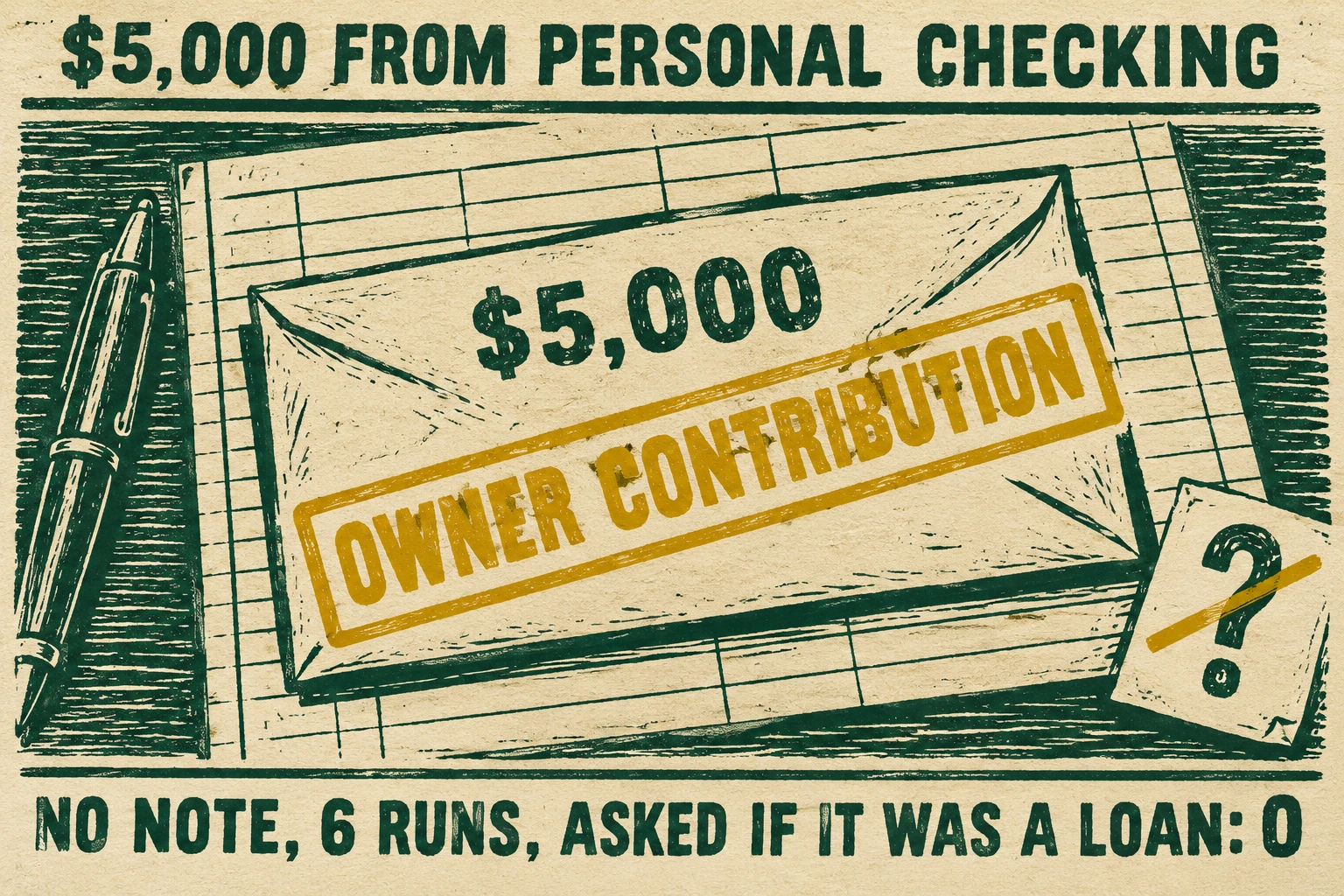
Contribution happened to be the right answer here, but the models assumed it. Had Maya lent the business that money, everything they saw would have looked exactly the same. Every run answered with a table, and a table that is right on nearly every line is the kind you approve in one pass. The $5,000 sat in that table in the same bold type as the right fixes, and none of the runs without the note told the owner a choice had been made.
IRS Publication 583 makes the same split for record keeping: it suggests a checkbook with room to identify the source of each deposit as "business income, personal funds, or loans"⁹, the three readings of Maya's line.
What else the audit prompt fixed
Our September had 13 bank lines with categories already set: 7 wrong, 4 right, 2 whose purpose the data can't show. The seven wrong ones:
September 1, $5,000 from Maya's personal checking, in Sales: Owner Contribution in all 12 runs.
September 5, a $1,150 SBA loan payment, all in Interest Expense: split in all 12 into $980.40 of principal and $169.60 of interest, from the loan statement in the notes. Only the interest is an expense.
September 10, $1,500 to business savings, in Uncategorized Expense: a transfer to savings in all 12.
September 12, a $3,412.18 Chase card autopay, in Uncategorized Expense: a card payment in all 12.
September 15, $2,200 to the IRS, in Uncategorized Expense: Owner's Draw in all 8 Haiku and DeepSeek runs. Sol left it there in all 4 of its runs until the tax type is known, three of them adding that it's Owner's Draw if it paid Maya's personal income tax.
September 19, a $2,000 Zelle to Maya, in Uncategorized Expense: Owner's Draw in all 12.
September 28, a $750 Zelle from J. Okafor, in Sales: applied to open invoice INV-1043 in all 12, so the sale isn't counted twice.
Those seven mistakes put $5,750 into Sales that wasn't new sales, and $10,092.58 into expense accounts that shouldn't have been booked as expenses. Owner money in Sales makes a month look better than it was; transfers and loan principal in expenses make it look worse. Bloch's screenshot reports the same kind of fix on his personal money: 731 category corrections across 13,946 transactions, with "151 Venmo funding entries changed from expenses to transfers" as the first key fix it lists².
Ask every time, or say it once
The review prompt from our earlier tests tells the model to ask instead of guessing. It carries these rules:
Review only. Use only the data I paste. Don't post, change or delete anything in my books. Don't guess what a purchase was for from the merchant name alone: if you can't tell, mark it ASK and write one short question I can answer. Flag anything that needs my accountant instead of deciding tax treatment.
With nothing about owner money in the notes, Haiku asked about both the $5,000 and the $2,000 Zelle in all 4 of its runs in our Claude Haiku 5.5 test, and Sol in both of its runs. DeepSeek booked the $5,000 as Owner Contribution in both of its runs and asked once, about the Zelle. Haiku's version: "Was this $5,000 from your personal checking a capital contribution to the business (Owner Contribution), or a loan you're expecting repaid?"
Asking is the right call, and it also means you give the same answer each time you run the prompt. With the owner-money line in the notes, 5 of 6 runs asked nothing about owner money, and Haiku's second run still wrote, in its section for the accountant, "Confirm the 2026-09-01 $5,000 was not intended as a loan, since that would change its treatment."
So Bloch's prompt let the models pick a default without saying so, ours made Haiku and Sol ask, and DeepSeek booked a contribution either way.
When the money is a loan from the owner
With the loan sentence in the notes and our review prompt, 2 runs per model, 6 of 6 runs booked a loan from the owner.
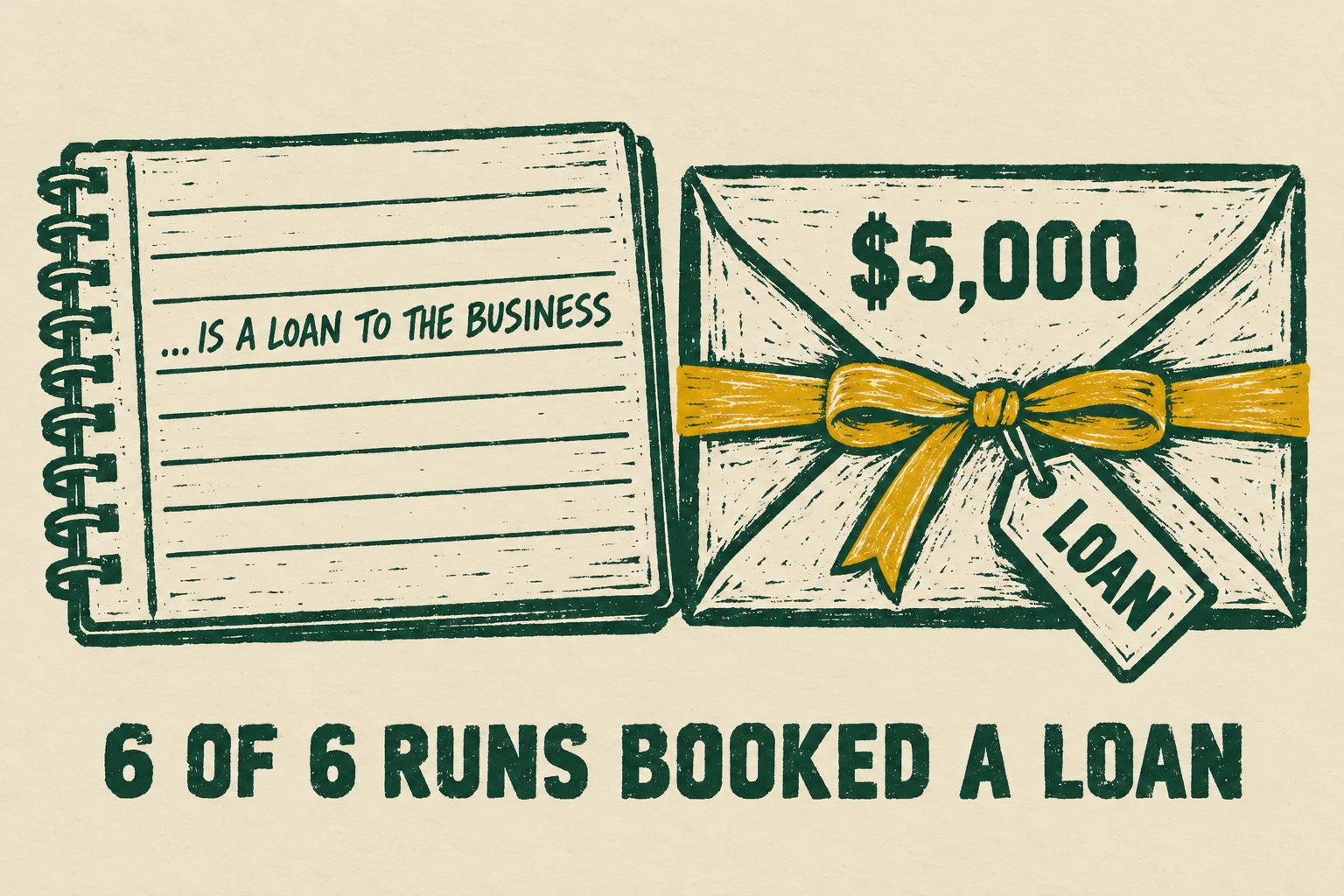
None put the $5,000 in Owner Contribution, income or the SBA Loan account, which was the only loan account on the chart and the easy wrong move. All 6 flagged that there was no owner-loan account to use. Haiku's first run asked, "Which account should hold this loan, or should I create one?" The rest sent it to the accountant to set up.
Intuit's equity page says "Loans are not equity because the owner does not gain ownership from the loan and expects to be reimbursed in the future"¹. We found no IRS page on how it treats an owner lending to their own single-member LLC, so ask your accountant about the tax side of that case.
Owner's draw: the money you pay yourself
The $2,000 Zelle to Maya was Owner's Draw in all 12 runs of Bloch's prompt, with or without the note. IRS Publication 334 says "You can't deduct your own salary or any personal withdrawals you make from your business"¹⁰, so a Zelle to yourself left in Uncategorized Expense understates your profit.
How to run the audit prompt on a month you've closed
Pick a closed month, so nothing it suggests lands in work you're still doing.
Pull a transaction report for your business checking that shows each line's date, description, amount and current category.
Write short notes: the business in one line, the last four digits of each account (yours included), your chart of accounts (your list of categories), anything a bank line can't show, like a loan's principal and interest split or open invoices, and the owner-money line. Our notes named ...7790 as Maya's personal checking, and the models gave that as the reason the $5,000 was owner money.
Paste the prompt, the notes and the report into a chat with no QuickBooks or Xero connector turned on. Bloch's prompt says "change", and even a "review only" line, like the one in our rules above, is an instruction to the model, not a limit on what a connected tool can do.
Check every line moved into or out of Sales, an expense account, Owner Contribution or Owner's Draw, every line kept without a reason, and every total; one of our runs got a sum wrong. Make the changes in your books yourself.
For a check of the whole profit and loss rather than single lines, see our guide to reviewing your QuickBooks P&L with ChatGPT or Claude. Our page on ChatGPT for bookkeeping covers what a chat model can and can't do with your books.
What went wrong
Without a "don't guess" rule, DeepSeek left guesses standing under Bloch's prompt: the $1,850 mobile deposit stayed in Sales in 4 of 4 runs and the $400 Venmo in Office Supplies in 3 of 4. Sol and Haiku flagged both in all 8 of their runs.
One Haiku summary said September Sales "drops from 8,600.00 to 1,850.00". The three lines in Sales add to 7,600.00. Its categories were right.
One DeepSeek loan run labeled the $5,000 "Transfer between my accounts / owner loan to business". The owner-loan half is right, but Maya's personal checking isn't one of the business's accounts, so it wasn't a transfer between them.
None of the 6 runs of Bloch's prompt with the owner-money line moved the $1,850 deposit, which doesn't show its source, into Owner Contribution.
The best fixes came from facts outside the bank feed: the loan split from a loan statement, the invoice match from an open-invoice list, and the answer on the $5,000 from a sentence only the owner can write. Whatever reviews your bank lines, those records still have to be kept somewhere, including what the business owes you.
How we tested
The books: a made-up September for a single-member LLC on QuickBooks Online (Fernwood Candle Co.), with its account list, chart of accounts, an SBA loan statement and one open invoice. We wrote down the right answers before the first run.
Two prompts: Bloch's, word for word plus one line telling the model to answer only from the pasted data, on 13 bank lines that already had categories; and our review prompt with the rules above on 6 checking lines. The before numbers for the review prompt come from our October 4, 5 and 8 tests.
24 runs on October 9, 2 per model for each version of the notes, about 4.5 cents in total. GPT-6.1 Sol ran through OpenAI's Codex on a ChatGPT plan, not in ChatGPT Finances; Haiku and DeepSeek ran through OpenRouter, a service that sells access to many AI models. We pasted the data in; no bank or QuickBooks account was connected. We first published this test in our X article¹¹.
Where Booke fits
Most of this month was routine bank-feed work: transfers, a card payment, a loan payment, an invoice payment. The few lines that needed Maya, like the $5,000, were the ones a bank line can't explain. Booke is built for that split. It works inside the QuickBooks Online or Xero books you already have, with the bank feeds already connected there, so there's no new platform and no new bank connection. Routine lines go through transaction auto-categorization and matching. With our AI Bookkeeper for QuickBooks Online, unclear transactions are flagged for a human decision, and approved changes improve future QuickBooks automation. The AI Bookkeeper for Xero handles supported categorization and matching in Xero, and exceptions come to you. We built it to automate up to 80% of manual bank-feed work. AI Bookkeeper pricing is $129 per business per month.
FAQ
Does an owner contribution count as income?
Not in your books: it goes to an equity account, not Sales⁴. All 12 runs of Bloch's audit prompt moved the owner's $5,000 out of Sales. IRS Publication 583 suggests marking each deposit's source as business income, personal funds or loans⁹; ask your accountant how yours is treated for tax.
What type of account is an owner contribution?
Equity. In QuickBooks Online, Intuit sets it up with the Equity account type and the Owner's Equity detail type³. In Xero, it's funds introduced⁵.
Is an owner's draw an expense?
No. Intuit records draws as "reductions of equity, not expenses"¹, and IRS Publication 334 says you can't deduct personal withdrawals from your business¹⁰.
How do I pay myself from a single-member LLC?
By default, a single-member LLC's activity goes on the owner's own federal tax return, the owner pays self-employment tax the same way a sole proprietor does¹², and the owner generally isn't an employee of the LLC¹³. Intuit's instructions for a sole proprietor are to pay yourself with an owner's draw, not through payroll⁸. If your LLC elected to be taxed as a corporation, different rules apply; ask your accountant.
Keep reading
Claude Haiku 5.5 for small business bookkeeping: we tested it on a month of books
ChatGPT Finances for small business: what it sees, and 5 bookkeeping prompts we tested
Connect an AI agent to QuickBooks: what it read, what it wrote, and whose name the audit log shows
Sources
Intuit, What is equity?, updated August 5, 2026.
Ethan Bloch (@ebloch), ChatGPT Finances audit prompt and results, X, October 8, 2026.
Intuit, Add an owner or partner to your books in QuickBooks Online, updated August 5, 2026.
Intuit, Record an owner's contribution or capital investment in your business in QuickBooks Online, updated August 5, 2026.
Xero, Manage funds in and out of your business. Read October 9, 2026.
Intuit, Set up a loan in QuickBooks Online, updated August 5, 2026.
Xero, Set up a loan in Xero. Read October 9, 2026.
Intuit, Set up and pay an owner's draw, updated August 5, 2026.
IRS, Publication 583, Starting a Business and Keeping Records, revised December 2024.
IRS, Publication 334, Tax Guide for Small Business, for 2025 returns.
Vadim Chumak (@vadimvchumak), Two AIs fixed 7 of 7 planted bookkeeping mistakes. Both booked the owner's $5,000 without asking, X, October 9, 2026.
IRS, Single member limited liability companies. Read October 9, 2026.
IRS, Publication 3402, Taxation of Limited Liability Companies, revised March 2020.