Will AI replace accountants? What the job data and research show

Will AI replace accountants? On the evidence available in 2026, no. The US Bureau of Labor Statistics projects employment of accountants and auditors to grow 5% from 2025 to 2035, and says automating routine tasks is not expected to reduce overall demand for them. What AI is changing is the work inside the job: less data entry, more review, client communication and analysis.
That answer comes with two qualifications. It applies to accountants, not to every role in accounting, and it depends on how firms check what AI produces. Both are covered below, with the data behind each point.
What the job projections say
The Bureau of Labor Statistics publishes employment projections by occupation in its Occupational Outlook Handbook. Its current projections run from 2025 to 2035.
For accountants and auditors, the handbook counts 1,595,200 jobs in 2025 and projects 5% growth over the decade, which it classifies as faster than the average for all occupations. It expects about 115,300 openings a year, many of them from people who retire or move to other occupations.
The handbook addresses AI directly. It says some routine accounting tasks may be automated as cloud computing, artificial intelligence and blockchain become more widespread. Although these technologies will likely increase accountants' efficiency, the change is not expected to reduce overall demand. Automating routine tasks such as data entry will instead make accountants' advisory and analytical duties more prominent.
A projection is an estimate, and the handbook ties accountants' employment growth to the health of the overall economy. It does show the direction the federal statistics agency expects, and that direction matches what the research on AI-assisted accounting has found so far.
Accountants and bookkeepers get different answers
The same handbook treats bookkeeping, accounting and auditing clerks as a separate occupation, and its outlook there is weaker. It counts 1,532,400 jobs in 2025 and projects a 6% decline by 2035, about 85,600 fewer positions.
Two details matter before reading that as proof that AI is replacing bookkeepers. The handbook's outlook summary for clerks does not name a cause for the decline. And it still expects about 144,100 openings a year over the decade, all of them to replace people leaving the role.
The handbook describes clerks as workers who compute, classify and record data to keep financial records complete and accurate. It counts bookkeepers in this group: bookkeeping clerks, also known as bookkeepers, are often responsible for some or all of an organization's general ledger.
Its list of typical duties shows why the answer for this group is less clear-cut. Clerks post financial transactions into accounting software, assign each cost and income item to an account, check figures and postings for accuracy, and reconcile or report differences in the records. Several of those duties overlap with what the accountants' page calls routine and automatable. Others, such as finding and explaining a difference in the records, are review work.
The category is also wide. The handbook notes that some clerks are full-charge bookkeepers who maintain an entire organization's books, while others handle specific tasks such as accounts payable. Many of their additional functions, including billing and tracking overdue bills, require them to communicate with clients.
In our reading, the more a role consists of entering and coding transactions, the more exposed it looks. The more it consists of review, reconciliation and client contact, the closer it sits to the accountants' outlook.
Which parts of the work AI is taking
The tasks moving to software first are repetitive and high in volume.
Data entry and processing is the clearest case. In Intuit's 2026 Accountant Technology Survey, an online survey of 725 US accounting professionals conducted in May 2026, 88% said they had used AI for at least one client service in the previous year. Data entry and processing was the most common use, at 54%.
Transaction categorization and document matching belong to the same group. Most bank-feed lines repeat from month to month, the same vendor usually lands in the same business expense category, and a receipt either matches a transaction or it does not. Both are repeated decisions over structured data.
Adoption is broad but not yet deep. In the same survey, 30% said AI is embedded as the default in their daily work, while 54% use it situationally. The wider set of adoption figures, with their sources and limits, is collected in our AI in accounting statistics review.
What the research found about accountants working with AI
Field evidence comes from Jung Ho Choi and Chloe Xie, whose paper "Human + AI in Accounting: Early Evidence from the Field" appeared in the Journal of Accounting Research on 16 April 2026. It combines a survey of 277 professional accountants, field data from an AI-enabled accounting platform serving 79 small and medium-sized businesses, covering more than 200,000 transaction-level records, and a framed field experiment.
Four of its findings bear on the question of replacement.
Effort moved rather than disappeared. Adoption of generative AI was associated with productivity gains and a shift of accountants' time away from routine data entry toward business communication and quality assurance.
Reporting improved. AI use was associated with more granular ledgers and faster month-end closing.
People stepped in where the software was unsure. Accountants intervened selectively when the AI's confidence scores were low, which the authors read as complementarity between professional expertise and AI.
Blind reliance carried risk. In the experiment, AI assistance improved classification accuracy on average, but relying on AI recommendations that departed from the consensus could increase the risk of error.
The authors conclude that in practice AI is most effective as a tool that augments professional judgment rather than replacing it.
What a review point looks like
Most vendors say people stay in the loop without saying where the loop sits. The Choi and Xie paper gives one answer: accountants stepped in when the AI's confidence scores were low. A month of bank-feed lines for a small client shows how that plays out.
Take a client with a few hundred transactions in a month. Most of them repeat: the same software subscription, the same payroll provider, the same utility. For lines like these, a categorization tool with a history of the client's books can propose an account with high confidence, and a person scanning the batch has little to change.
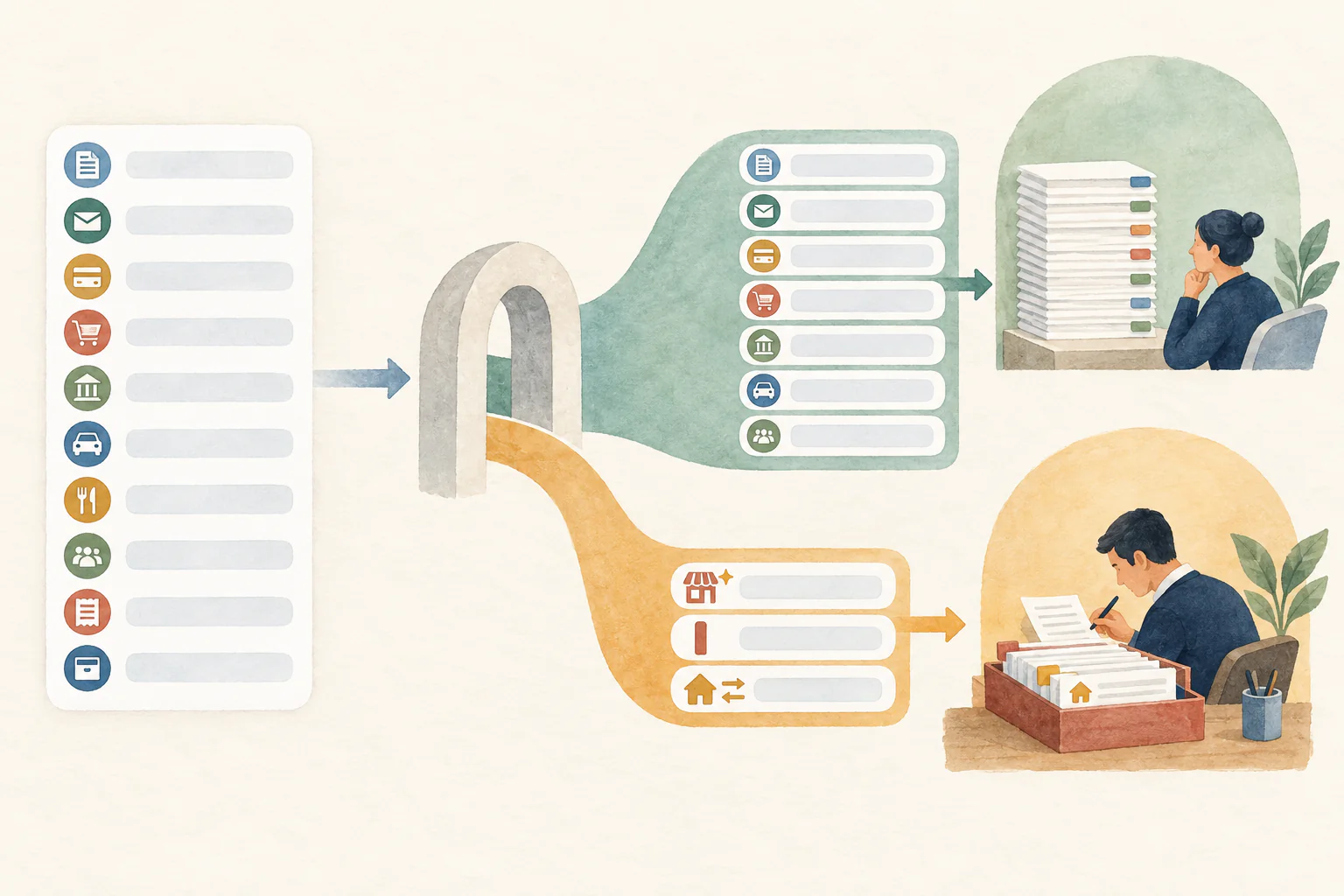
A smaller group needs a decision. A payment to a vendor the client has never used before. A charge at a store that sells both office supplies and personal items. An amount far larger than usual for that vendor. A transfer that could be a loan repayment or an owner's draw. These are the lines where a wrong category distorts the profit and loss statement, and where the person reviewing needs to know the client or ask them.
Designing the review point means deciding, in advance, which of those cases always go to a person regardless of what the software says. Owner transactions, large one-off amounts and anything with a tax consequence are common candidates. The rest can move on confidence alone, with a person sampling the output.
This is an illustration, not a benchmark: the share of lines that need a human will differ by client, industry and the quality of the historical books.
Skills that gain value
If the routine share of the work shrinks, the skills around it matter more. The handbook's own list of important qualities for accountants and auditors reads like a description of the work that stays.
It names analytical and critical-thinking skills: critically evaluating data, identifying issues in documentation and suggesting solutions. Reviewing AI output is that skill applied to a new source of entries.
It names communication skills: listening to and discussing facts and concerns from clients and managers, and discussing results in meetings and written reports. The Choi and Xie paper found accountants' effort shifting toward business communication, which points the same way.
It also names attention to detail when compiling and examining documents. A proposed category can look plausible and still be wrong for a particular client, and the experiment in the paper found that relying on AI recommendations that departed from the consensus could increase errors.
What stays with people
Two kinds of work stay with people: decisions where a wrong answer is expensive, and work that depends on knowing the client.
The first is review. A transaction the software is unsure about, an unusual amount, a vendor that could belong to two accounts: each needs someone who knows the client's business. The finding that accountants intervene when AI confidence is low describes this division of labor in practice. Sign-off belongs here too. Asked what role AI should ideally play in client work and deliverables, 40% of the accountants in Intuit's survey wanted AI as a support tool, and 34% wanted it to draft with a human reviewing and signing off.
The second is advisory and analytical work, the duties the Bureau of Labor Statistics says the automation of routine tasks will make more prominent. Explaining what the numbers mean for a particular business, and answering the questions a client brings, depends on context that sits outside the ledger.
Where the risk sits
The risk to people in the profession is narrower than the headlines suggest, and it is concentrated.
Reading the task data together, roles that consist almost entirely of data entry look the most exposed. The handbook projects a decline for clerks without naming a cause, so that link is our reading, not a BLS finding.
Inside firms that adopt AI, the larger risk is trusting its output without checking it. The experiment in the Choi and Xie paper found that relying on non-consensus AI recommendations could increase errors. A confident-looking suggestion is not evidence that an entry is right.
There is also a quieter bottleneck. In Intuit's survey, 30% of respondents named manual data cleanup as the top barrier to doing more proactive advisory work. Clean, consistently categorized records make every later review faster, whether the first pass came from a person or from software.
What this means for a firm
Our reading of the evidence for a firm deciding how to use AI comes down to four choices.
Put the review point where the software is least certain. If a tool reports confidence, route low-confidence items to a person and let routine, high-confidence items move faster. That is the pattern the field data showed accountants following.
Keep a named person signing off on anything that reaches a client. That is also the arrangement 34% of the accountants in Intuit's survey preferred: AI drafts, and a human reviews and signs off. A named reviewer makes it clear who answers for the work.
Measure the whole workflow rather than the automated step alone. Time spent reviewing and correcting AI output is part of the cost, and a faster first pass that creates more corrections is not a saving.
Move staff time toward the work that grows. The handbook says automating routine tasks will make advisory and analytical duties more prominent. The hours freed from data entry are the natural place to build that capacity.
Where Booke fits
Booke AI is built around the same division of labor. Its AI Bookkeeper works in bank feeds already connected to QuickBooks Online, categorizes eligible transactions, matches documents, and routes low-confidence or policy-sensitive cases to people, who keep final review and close responsibility. The AI bookkeeping page describes the operating model, the bookkeeping automation software page covers the workflow, and automatic transaction categorization covers the categorization step.
Frequently asked questions
Will accountants exist in 10 years?
The Bureau of Labor Statistics projects employment of accountants and auditors to grow 5% between 2025 and 2035, with about 115,300 openings a year. It expects AI to automate routine tasks without reducing overall demand for accountants.
Will bookkeepers become obsolete?
Current projections do not point that way, but the outlook is weaker than for accountants. The handbook projects a 6% decline for bookkeeping, accounting and auditing clerks by 2035, yet still expects about 144,100 openings a year. The exposure is concentrated in roles that consist mainly of entering and coding transactions.
Will CPAs be replaced by AI?
Nothing in the current data points that way. The handbook's accountants and auditors occupation, which it projects to grow, includes public accountants, many of whom are CPAs. Publicly traded companies are required to have CPAs sign the documents they file with the Securities and Exchange Commission, including annual and quarterly reports.
Which accounting tasks is AI most likely to take over?
Repetitive, high-volume tasks: data entry and processing, categorizing routine transactions and matching documents to them. Data entry and processing was the most common AI use among the accountants Intuit surveyed in 2026.
Is accounting still a good career with AI?
The Bureau of Labor Statistics projects demand for accountants to grow, and the Choi and Xie research found accountants' effort shifting toward business communication and quality assurance. Building those skills moves a career in the same direction as the job.
Sources