Balance sheet template: a free Excel sheet and a small business example
A balance sheet shows what your business owns, what it owes and what's left for you, the owner, on one date. Assets always equal liabilities plus owner's equity¹: every dollar the business has came either from money it owes or from the owner, including profit left in the business. On September 30, 2026, a small candle business had $22,573.74 in assets, $16,331.76 in liabilities and $6,241.98 in owner's equity.
Download the free balance sheet template (Excel, 23 KB, no sign-up). It totals each section and shows the gap when the sheet doesn't balance. The candle business is filled in as an example. We build Booke AI, AI bookkeeping software for QuickBooks Online and Xero.
Small business balance sheet example
Here is the candle business's balance sheet on September 30, 2026, next to the same date a year earlier. It's the business from our profit and loss statement example. That P&L shows $34,401.74 in net profit over those twelve months. Its books are on a cash basis: a sale counts when the customer pays, and an expense when the business pays it. On an accrual basis, a sale counts when you earn it and an expense when you incur it, even before any money moves. Our guide to cash vs accrual accounting compares the two.
Sep 30, 2026 | Sep 30, 2025 | |
|---|---|---|
Assets | ||
Checking | $7,573.74 | $18,000.00 |
Savings | $15,000.00 | $12,000.00 |
Total assets | $22,573.74 | $30,000.00 |
Liabilities | ||
Credit card | $2,758.14 | $1,874.36 |
Sales tax owed | $338.42 | $1,385.40 |
SBA loan, due in the next 12 months | $11,764.80 | $11,764.80 |
Total current liabilities | $14,861.36 | $15,024.56 |
SBA loan, due after 12 months | $1,470.40 | $13,235.20 |
Total liabilities | $16,331.76 | $28,259.76 |
Owner's equity | $6,241.98 | $1,740.24 |
Total liabilities and owner's equity | $22,573.74 | $30,000.00 |
Assets are what the business owns. Here that's only cash. The business expenses its wax and jars when it buys them, so it carries no inventory, and it has no equipment on its books.
Liabilities are what it owes. The card balance is September's charges, paid in October. The sales tax is September's tax, paid to the state on October 20.
Owner's equity is assets minus liabilities: the owner's share of the business on paper.
Current lines are what the business expects to turn into cash or pay within 12 months. Long-term lines, also called non-current, are everything later¹. The part of a loan due in the next 12 months counts as current². A balance sheet split this way is called a classified balance sheet.
The split gives a lender one of the first numbers they check: the current ratio, current assets divided by current liabilities. All of the candle business's assets are current, so its current ratio is $22,573.74 divided by $14,861.36, or 1.52.
Owner's equity starts the year at one figure and changes in three ways:
Owner's equity | Sep 30, 2026 |
|---|---|
At the start of the year | $1,740.24 |
Money the owner put in | +$2,500.00 |
Money the owner took out | −$32,400.00 |
Net profit for the year, from the P&L | +$34,401.74 |
At the end of the year | $6,241.98 |
Our guide to the balance sheet and income statement shows how net profit ties the two reports together.
A corporation shows the same thing as stock and retained earnings, the profits it has kept over the years. QuickBooks Online includes this year's net income in equity³. When a new fiscal year starts, it moves last year's net income to Retained Earnings⁴.
Why cash fell in a profitable year
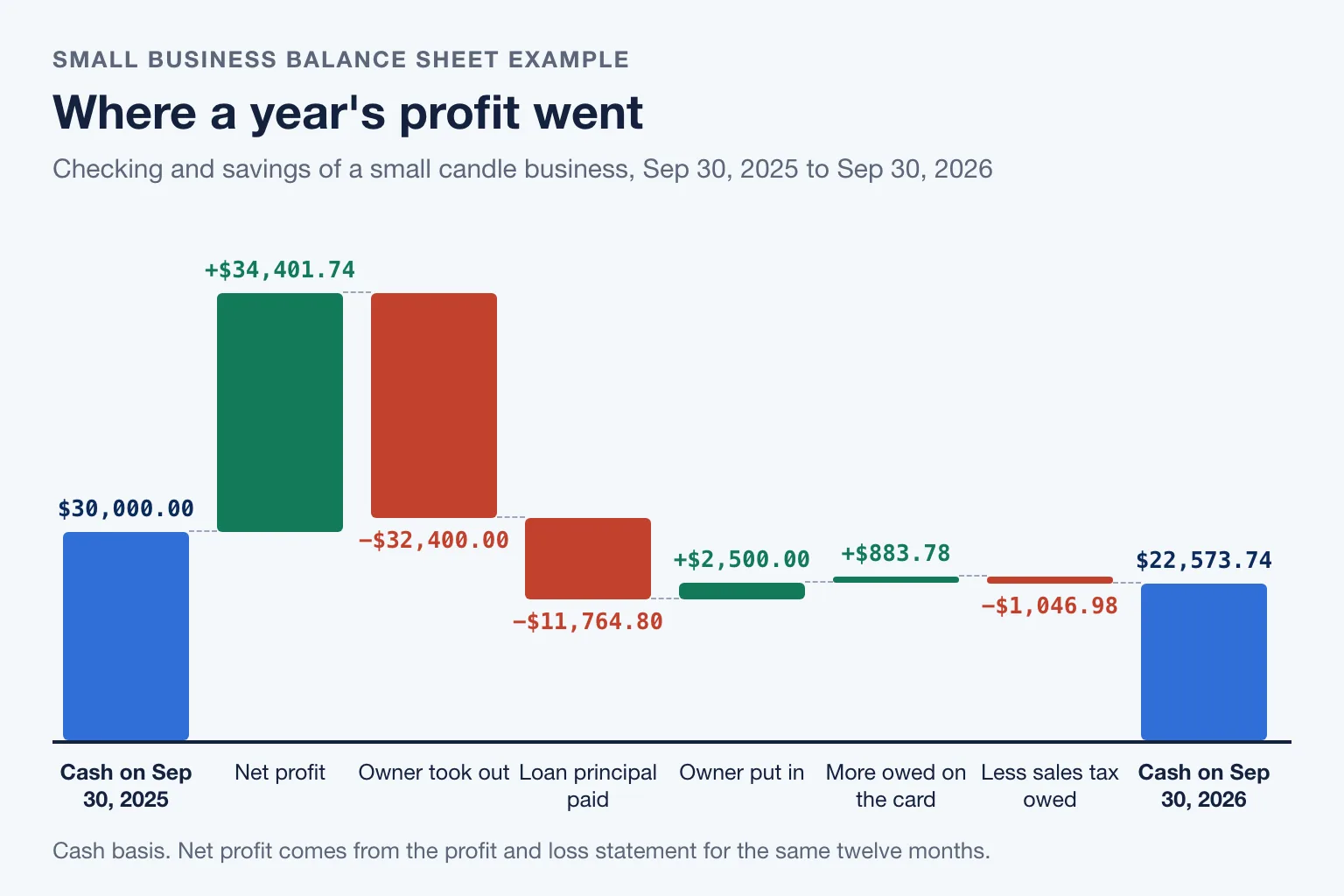
The candle business made $34,401.74 in net profit, yet on September 30, 2026 its checking and savings held $7,426.26 less than a year earlier. Comparing the two balance sheets shows where the money went:
What changed during the year | Effect on cash |
|---|---|
Net profit | +$34,401.74 |
Money the owner took out, including $8,400 of estimated income tax | −$32,400.00 |
Loan principal paid back | −$11,764.80 |
Money the owner put in | +$2,500.00 |
More owed on the credit card | +$883.78 |
Less sales tax owed | −$1,046.98 |
Change in checking and savings | −$7,426.26 |
The owner took out almost all of the profit. The loan principal came out of cash too, but it isn't an expense, so it never shows on the P&L. The template builds a version of this table for your business from its two date columns. Use your fiscal year-end as the date, so net profit and the money in and out cover the same twelve months as the two columns.
How to make a balance sheet
Before you start, gather these for the date you pick:
bank and card statements
loan statements
the sales tax, payroll taxes and wages owed on that date
your P&L for the year so far
Pick the date. Most owners use the last day of a month, a quarter or the year. Use the same basis, cash or accrual, as your P&L.
List what the business owns on that date: bank balances, money customers owe you (accounts receivable), inventory, and equipment or vehicles. Enter equipment and vehicles at what you paid, minus depreciation to date, the part of their cost already written off⁵.
List what the business owes: card balances, unpaid bills, sales tax, payroll taxes and wages owed, and loans. Split each loan into the principal due in the next 12 months and the rest. The lender's payment schedule shows both. On a cash basis, leave out money customers owe you and unpaid bills. Those belong on an accrual balance sheet.
Work out owner's equity: equity at the start of the year, plus money you put in, minus money you took out, plus this year's net profit from your P&L.
Check that total assets equal total liabilities plus owner's equity. If they don't, something is missing or entered wrong. The FAQ below lists the usual causes.
Check each line against a statement from outside your books, as in the next section.
The free balance sheet template does the adding. Next to your date it has a column for the same date a year earlier, and its Difference line shows 0 when the sheet balances. It checks your bank, card, loan and tax lines against the statements you type in. It also works out three numbers lenders look at: working capital (current assets minus current liabilities), the current ratio and debt to equity (total liabilities divided by owner's equity).
Check each line against a statement
QuickBooks Online and Xero record every transaction on two sides, so the balance sheet adds up even when a transaction sits in the wrong account. To catch those errors, check each line against a statement from outside your books:
Balance sheet line | Check it against | Candle business, Sep 30, 2026 |
|---|---|---|
Checking and savings | Bank statements for the same date | $7,573.74 and $15,000.00 |
Credit card | The card balance on that date | $2,758.14 |
Loans | The lender's statement | $13,235.20 |
Sales tax owed | Your sales tax returns for periods up to that date, minus what you've paid | $338.42 |
Payroll taxes and wages owed | Your payroll report for that date | none |
Net profit in equity | Your P&L for the year to the same date | $34,401.74 |
When a line doesn't match, first rule out timing: a check or deposit that hasn't cleared the bank yet. Your reconciliation report lists those. A gap that's left usually points to bank transactions booked to the wrong account. Here is what three common mistakes would have done to the candle business's balance sheet:
Mistake in the books | Balance sheet shows | Statement says |
|---|---|---|
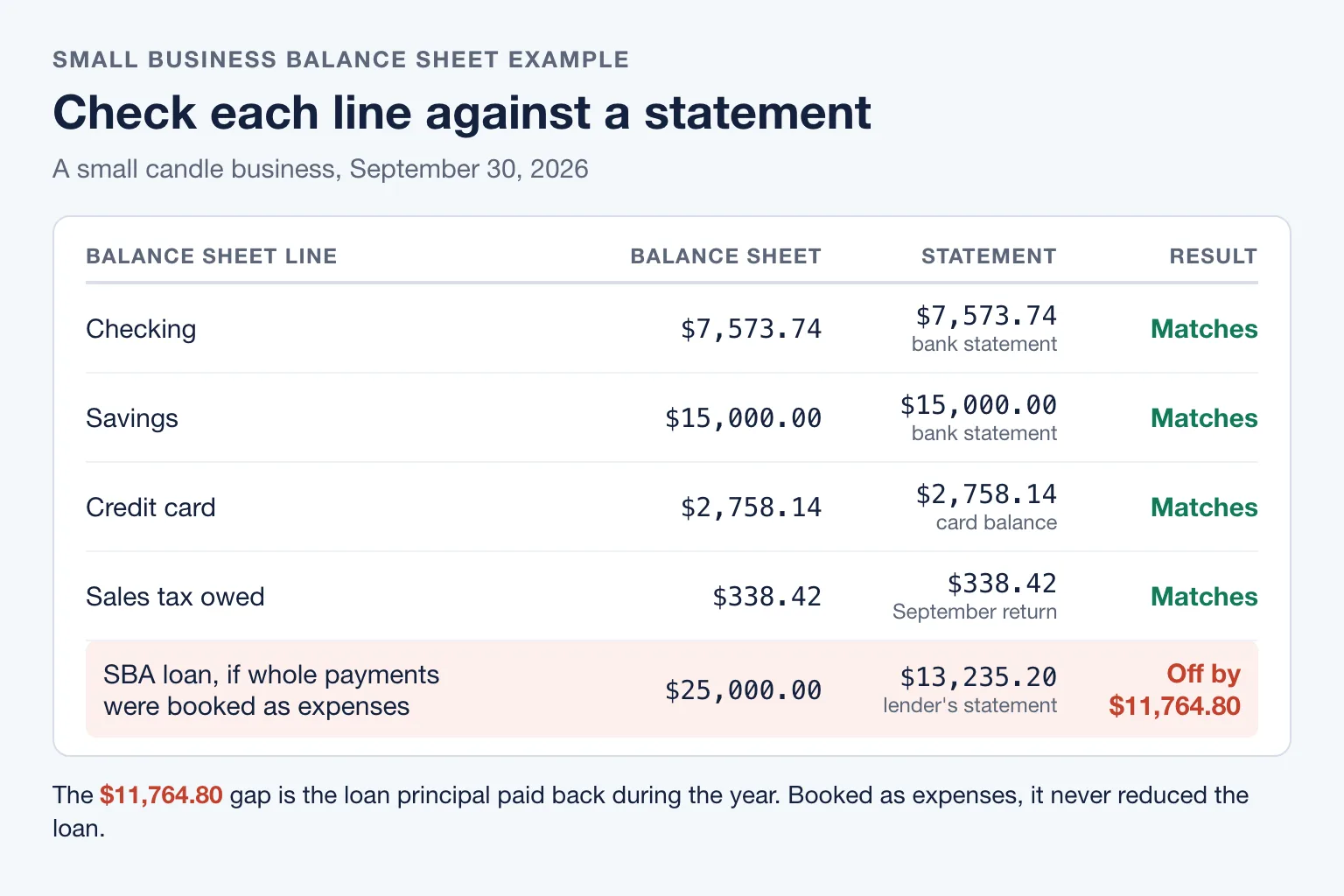
Whole loan payments booked as expenses | SBA loan $25,000.00 | Lender: $13,235.20 |
Sales tax collected booked as sales, tax payments as an expense | Sales tax owed $1,385.40 | September return: $338.42 |
Card left off the books, card payments booked as expenses | Credit card $0 | Card balance: $2,758.14 |
In the first row, the $11,764.80 gap is the principal paid back during the year. Booked as expenses, it also cut the year's profit by the same amount. A small loan gap can also be timing. A payment made on the last day of the month may reach the lender a few days later, so the lender's statement for that date doesn't show it yet.
If owner's draws (money the owner takes out) are booked as expenses, the statement checks won't catch that. With the owner's $32,400 of draws booked that way, net profit would drop by $32,400. Money taken out would drop by the same $32,400, so owner's equity would still end the year at $6,241.98. The mistake shows only as $0 on the money-taken-out line and as $32,400 of extra expenses on the P&L, as our profit and loss statement example shows.
Reconcile your bank and card accounts before these checks. Our guide to reconciling in QuickBooks Online walks through it. In QuickBooks Online, also look at two accounts: Opening Balance Equity and Uncategorized Asset. Opening Balance Equity holds the opening balances entered when accounts were set up⁶. If either account still holds an amount, ask your accountant about it.
How to run a balance sheet in QuickBooks Online and Xero
In QuickBooks Online:
Go to Reports, then Standard reports, and open Balance Sheet³.
Set the report date.
Choose Cash or Accrual as the accounting method⁷.
Run the report. To keep a copy, select Export/Print, then Export to Excel⁸.
To see a year earlier next to it, search for Balance Sheet Comparison and set custom dates³. The Balance Sheet report is included even on QuickBooks Online Free and Lite, but Balance Sheet Comparison isn't⁹. On those plans, run the Balance Sheet once for each date.
In Xero, run the Balance Sheet report for the date you need. Xero reports can be compared across periods, so you can set the same date a year earlier next to it¹⁰.
Where Booke fits
Many balance sheet lines are built from bank transactions, such as sales tax payments and money the owner takes out. Booked to the wrong account, they can leave a sales tax balance that doesn't match your returns, or a profit figure that's off.
Every day Booke goes through your bank transactions in QuickBooks Online or Xero, sorts them into categories and matches receipts. It adds the ones it's sure about to your books and asks you about the rest. It works with the bank feeds already connected there, so you don't connect your bank again.
Booke costs $129 a month per business. See how Booke works for small business owners.
FAQ
Does a small business need a balance sheet?
Not always for taxes. If you're a sole proprietor, you usually file Schedule C, which has no balance sheet section¹¹. A partnership reports one on Schedule L, the balance sheet page of its return. It can skip Schedule L if its receipts for the year are under $250,000 and its assets at year-end are under $1 million, among other conditions¹². An S corporation can skip Schedule L when both its receipts and its year-end assets are under $250,000¹³. Lenders usually ask for a balance sheet anyway. The Small Business Administration (SBA) asks for one dated within 120 days before a 504 loan application is submitted¹⁴.
Does an LLC need a balance sheet?
It depends on how the LLC is taxed. If your LLC has one member and hasn't chosen to be taxed as a corporation, the IRS treats it as a disregarded entity. Its income and expenses go on your personal tax return¹⁵, usually on Schedule C, which has no balance sheet. A multi-member LLC taxed as a partnership files Form 1065, the partnership return. The return includes a Schedule L balance sheet unless the LLC meets the small-partnership test above¹². An LLC taxed as an S corporation files Form 1120-S, with the $250,000 test¹³.
Why doesn't my balance sheet balance?
In a spreadsheet, the usual causes are:
a missing line
a number entered twice
money you took out added instead of subtracted
a start-of-year equity that doesn't match last year's ending total
In the template, the Difference line shows the size of the gap.
Can owner's equity be negative?
Yes. Equity goes below zero when you've taken out more than the business earned plus what you put in, or when losses pile up. Then the business owes more than it owns, and a lender reads that as a warning.
How often should I make a balance sheet?
Make one for the last day of each month, together with your P&L, while you still remember the month's transactions. Tax returns use your year-end date. A lender may also want a recent one, as the SBA does.
Sources
Xero, Balance sheet basics for small business owners, May 15, 2026.
Xero, Current liabilities, July 23, 2026.
Intuit, Run a Balance Sheet report, updated August 5, 2026.
Intuit, Lock your books in QuickBooks Online, updated September 15, 2026.
IRS, Publication 946, How To Depreciate Property, 2025.
Intuit, Enter and manage opening balances in QuickBooks Online, updated August 25, 2026.
Intuit, Choose between cash and accrual accounting methods in QuickBooks Online, updated August 5, 2026.
Intuit, Export reports to Excel, updated August 4, 2026.
Intuit, Reports included in your QuickBooks Online subscription, updated August 10, 2026.
Xero, Financial reports, retrieved November 19, 2026.
IRS, Schedule C (Form 1040), Profit or Loss From Business, 2026 form.
IRS, Instructions for Form 1065 (2025), page reviewed April 30, 2026.
IRS, Instructions for Form 1120-S (2025), page reviewed April 30, 2026.
SBA, Form 1244, SBA 504 Borrower Information Form, effective March 27, 2025.
IRS, Single member limited liability companies, page reviewed July 27, 2026.