
Balance sheet vs income statement: what each tells a business owner

The income statement, also called the profit and loss statement or P&L, shows what the business earned and spent over a period, such as a month, and the profit or loss left over¹. The balance sheet shows what the business owns, what it owes and what belongs to the owner on a single date². The P&L tells you whether September made money. The balance sheet tells you where the money is now and who has a claim on it. QuickBooks Online and Xero build both reports from the same transactions.
We build Booke AI, AI bookkeeping software for QuickBooks Online and Xero.
Balance sheet vs income statement at a glance
Income statement (P&L) | Balance sheet | |
|---|---|---|
Answers | Did we make money? | What do we own and owe? |
Covers | A period, such as September 1 to 30 | One date, such as September 30 |
Main sections | Income, cost of goods sold, expenses | Assets, liabilities, equity |
Bottom line | Net income: income minus expenses | Assets equal liabilities plus equity |
Where these go | Sales, materials, rent, ads, loan interest, depreciation | Bank and card balances, unpaid invoices and bills, inventory, equipment, loans, sales tax you still owe, money the owner puts in or takes out |
With inventory tracking on in QuickBooks Online, products you buy to resell sit in an inventory asset account on the balance sheet until you sell them. Then their cost moves to cost of goods sold on the P&L³. Sales tax you collect stays in sales tax payable, a liability, until you file the return and pay it⁴.
Lenders often ask for both. The SBA's 504 loan application, for example, requires a balance sheet and an income statement dated within 120 days of submission⁵.
How the two reports connect
Net income from the P&L also lands on the balance sheet. On the QuickBooks balance sheet, equity includes the company's net income for the fiscal year to date². So the two reports always tie: if the P&L shows a $4,000 loss for the month, equity on the balance sheet falls by $4,000 between the start and the end of that month, unless the owner put money in or took money out.
That was true in our test books. Equity on the balance sheet fell by $4,042.08 between August 31 and September 30, exactly the loss on the September P&L. The owner did put money in and take money out that month, but those amounts were booked as income and expenses, so they're buried inside that $4,042.08. If you're working the other way, from two balance sheets to a period's profit, see how to calculate net income from a balance sheet.
What our test company's September reports showed
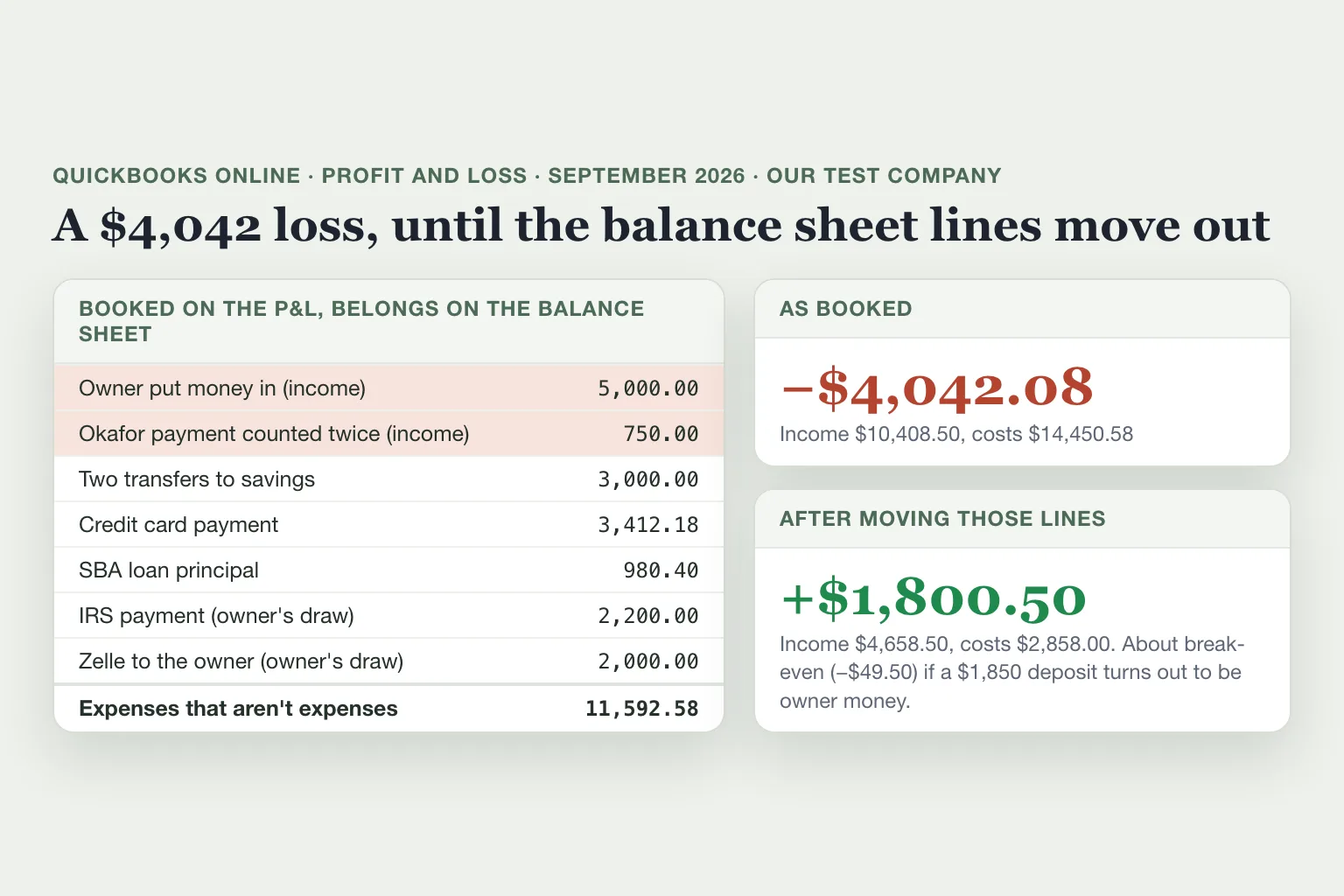
We ran both reports for September 2026 in our QuickBooks Online test company, a candle business with made-up books that we seeded on purpose with the kind of bank-feed lines owners leave uncategorized. The P&L showed a loss of $4,042.08: $10,408.50 of income against $14,450.58 of costs.
Most of the bank lines sat in Uncategorized Income and Uncategorized Expense, and several of them were never income or expenses at all. Our answer key for this month puts these on the balance sheet:
September line | On the P&L as | Where it belongs | Amount |
|---|---|---|---|
Owner moved money in from a personal account | income | equity: owner contribution | $5,000.00 |
Okafor's Zelle payment for an invoice already counted as a sale | income | matched to the invoice, which clears accounts receivable | $750.00 |
Two transfers to business savings | expenses | assets: savings | $3,000.00 |
Credit card payment | expense | liabilities: the card | $3,412.18 |
SBA loan payment, principal part | expense | liabilities: the loan | $980.40 |
Owner's personal estimated tax paid from the business account | expense | equity: owner's draw | $2,200.00 |
Zelle to the owner | expense | equity: owner's draw | $2,000.00 |
Money moved between your own accounts is a transfer and should be recorded as one⁶; nothing was spent. A card payment pays down the card⁷, and the purchases it covers are already on the P&L as expenses, so booking the payment as an expense too counts them twice. For a loan, QuickBooks records the payment against the loan account and the interest to an expense account⁸. Money the owner puts in goes to an equity account⁹, and so does money the owner takes out¹⁰. The $2,200 IRS payment is a draw here because it's the owner's personal estimated tax; payroll and sales tax payments aren't draws, so ask your accountant about yours. The $750 Okafor payment is the same one our cash vs accrual guide tracks.
Moving those lines takes $5,750 out of income and $11,592.58 out of costs. September then shows a profit of $1,800.50 instead of a $4,042.08 loss. One question is still open: a $1,850 mobile deposit with no customer name. If it's a sale, the profit stands. If it's owner money, September comes out at a $49.50 loss, close to break-even.
What the balance sheet showed that the P&L didn't
Each of those mistakes also left a trace on the balance sheet, and that's where an owner can spot them without knowing accounting rules. You compare balances to things you can check: bank statements, card statements, loan statements and the invoices customers still owe. If someone else keeps your books, our outsourced bookkeeping guide turns these into five checks to run each month.
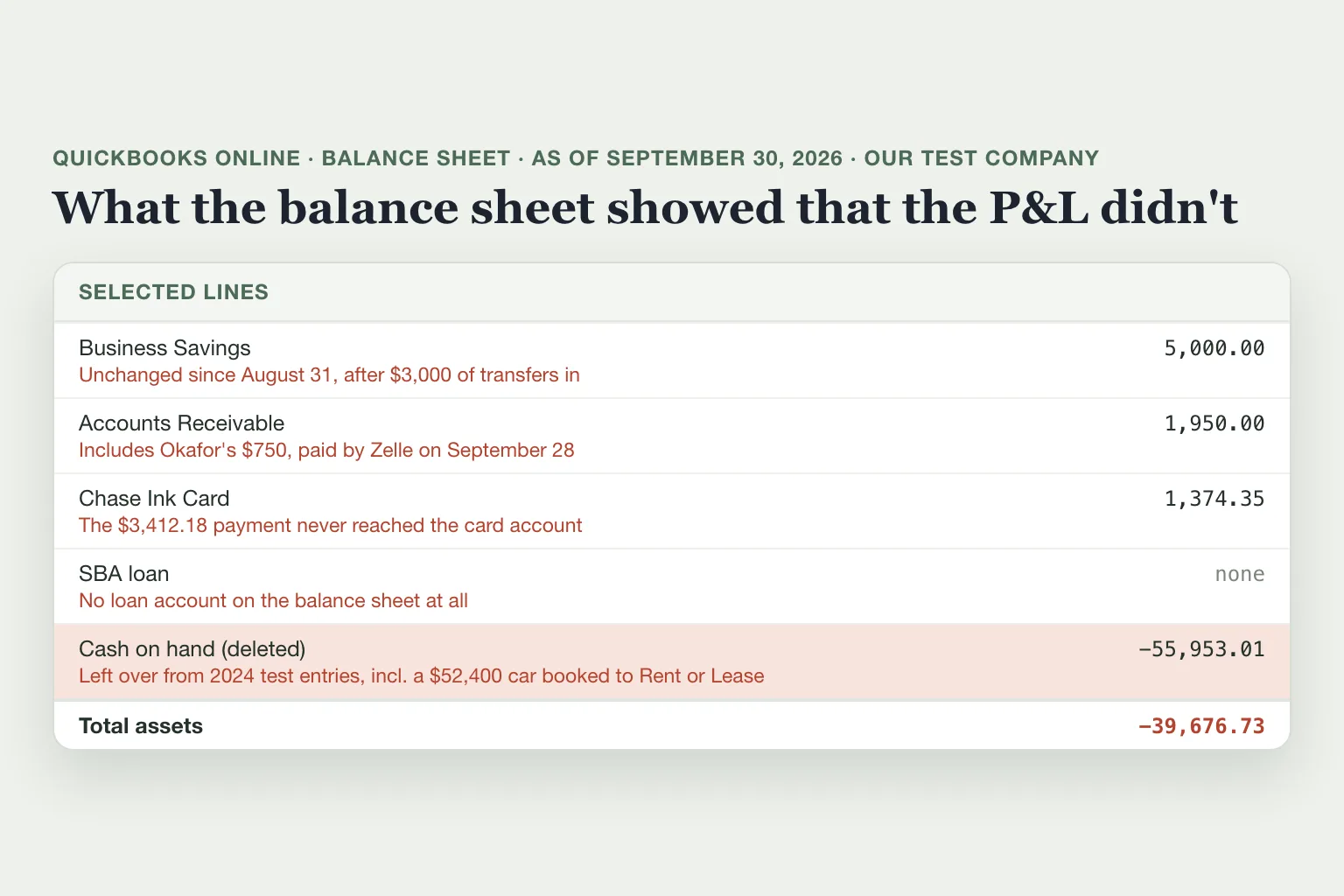
Business Savings showed $5,000.00 on September 30, the same as on August 31, even though $3,000 went into it during the month. If both transfers went through, savings should show $8,000.
The Chase card balance didn't go down after the $3,412.18 payment, because the payment never reached the card account.
There was no SBA loan on the balance sheet at all, so there was nothing for the principal to reduce.
Accounts Receivable showed $1,950, including the $750 Okafor paid on September 28.
The balance sheet also carried something that didn't start in September. In November 2024, early test entries in this company booked a $52,400 car purchase as Rent or Lease, paid from a Cash on hand account that never had the money. That account was later made inactive, and QuickBooks now lists it as Cash on hand (deleted) with a balance of minus $55,953.01. It drags total assets down to minus $39,676.73, something no real business can have. The report still balances: $1,374.35 of card debt plus equity of minus $41,051.08 comes to the same minus $39,676.73. Every entry has two sides, so the totals match even when one side lands in the wrong account.
A vehicle bought for the business belongs on the balance sheet as a fixed asset, with its cost reaching the P&L over time through depreciation¹¹. In QuickBooks that means a Fixed Assets account, for example one for vehicles¹². Booked as an expense, it made 2024 look $52,400 worse and left no vehicle on the books. Tax depreciation can differ from the books; your accountant decides how to deduct it.
How to read a profit and loss statement
Check the dates and the basis at the top. A P&L for one month and one for the year to date answer different questions, and cash and accrual reports count invoices at different times.
Read income first. Large round amounts, transfers from another account of yours and loan proceeds aren't sales.
Look at cost of goods sold and gross profit. Gross profit divided by income is your gross margin. If it slips, check costs and prices first, then whether a big materials order or a miscategorized line landed in that month.
Scan expenses for Uncategorized Expense and for any line called a transfer, a card payment, a loan payment or the owner's name. Those usually belong on the balance sheet.
Read net income last, then compare it with the same month last year or the month before.
How to read a balance sheet
Check that every bank and card balance matches its statement for the same date. In QuickBooks Online this check is a reconciliation; our reconciliation guide for QuickBooks Online walks through it step by step.
Check Accounts Receivable against the invoices customers still owe you, and Accounts Payable against the bills you still owe.
Find each loan and compare it with the lender's statement.
Compare what you'll have soon (bank balances, invoices you expect to collect and inventory you expect to sell) with what you'll owe soon (bills, card balances, sales tax and loan payments due within a year). Divide the first by the second; accountants call the result the current ratio.
Look in equity for owner draws and contributions. If you took money out or put money in and equity doesn't show it, those amounts are probably sitting on the P&L.
Treat a negative asset balance (other than a bank account you know is overdrawn), any Uncategorized Asset balance and a growing Opening Balance Equity as signs that something needs fixing.
Account types decide which report a line lands on: assets, liabilities and equity go to the balance sheet, income and expenses to the P&L. Our QuickBooks chart of accounts guide shows how to set them up.
Income statement vs profit and loss: the same report
"Income statement" and "profit and loss statement" are two names for one report¹. QuickBooks Online and Xero both call it Profit and Loss. Accountants and lenders often say income statement, and some use "statement of operations".
How to run both reports in QuickBooks Online and Xero
In QuickBooks Online²:
Go to Reports, then Standard reports.
Open Profit and Loss or Balance Sheet.
Set the report period and run the report.
Run the P&L for the month and the balance sheet as of the month's last day, so both reports describe the same September.
Xero has the same two reports, Profit and Loss and Balance Sheet¹³.
Where Booke fits
Most of the mistakes above start in the bank feed: a transfer, a card payment or an owner's Zelle gets added as an expense because nobody had time to sort it. Booke works inside the QuickBooks Online or Xero books you already have, with the bank feeds already connected there. Every day it categorizes new bank-feed transactions to the accounts in your chart and matches customer payments to the invoices they pay. Unclear transactions come to you for a decision. Booke automates up to 80% of manual bank-feed work for $129 per business per month. See how Booke works for small business owners.
FAQ
What comes first, the balance sheet or the income statement?
The income statement. Equity on the balance sheet includes the year's net income to date², so the balance sheet depends on the profit figure.
Should the balance sheet and income statement match?
They don't show the same numbers, but they should tie: the change in equity over a period equals that period's net income, plus money the owner put in and minus money the owner took out.
What are the three main financial statements?
The income statement, the balance sheet and the cash flow statement. The cash flow statement shows where cash came from and where it went during a period.
Can a business show a profit and still run low on cash?
Yes. Once the misbooked lines move, and counting the $1,850 deposit as a sale, our test company's September shows a $1,800.50 profit. Its checking account still fell from $14,250.00 to $9,526.27. Of that drop, $3,000 only moved to savings, so the business's cash fell by $1,723.73, even after the owner put in $5,000. The card payment, the loan principal and the owner's draws used cash without being expenses, and Juniper Home Goods still owed its $1,200 invoice, which the accrual P&L already counts as income.
What are red flags on a balance sheet?
A negative asset balance on an account that isn't overdrawn, bank balances that don't match the statements, receivables that include invoices customers have already paid, money in Uncategorized Asset, and a loan you know you have that isn't on the balance sheet.
Sources
Xero, What is a profit and loss statement?, July 9, 2026.
Intuit, Run a Balance Sheet report, updated August 5, 2026.
Intuit, Impacts of inventory tracking on the Balance Sheet and Profit & Loss reports in QuickBooks Online, updated August 5, 2026.
Intuit, File your sales tax return and record sales tax payments in QuickBooks Online, updated September 15, 2026.
SBA, Form 1244, Application for Section 504 Loans, revised December 2021.
Intuit, Transfer funds between accounts, updated August 3, 2026.
Intuit, Record your payments to credit cards in QuickBooks Online, updated August 5, 2026.
Intuit, Set up a loan in QuickBooks Online, updated August 5, 2026.
Intuit, Record an owner's contribution or capital investment, updated August 5, 2026.
Intuit, Set up and pay an owner's draw, updated August 5, 2026.
IRS, Publication 946, How To Depreciate Property, 2025.
Intuit, Set up an asset account in QuickBooks Online, updated August 5, 2026.

