
How to pay yourself from an LLC or small business: owner's draw vs salary

To pay yourself from an LLC with one owner and no corporate tax election, take an owner's draw: move money from the business account to your personal account and record it in an equity account, not as an expense¹. With two or more owners, the LLC is a partnership by default², and you take distributions, plus guaranteed payments if your operating agreement sets them. A salary through payroll comes into play only after an S corp or C corp election.
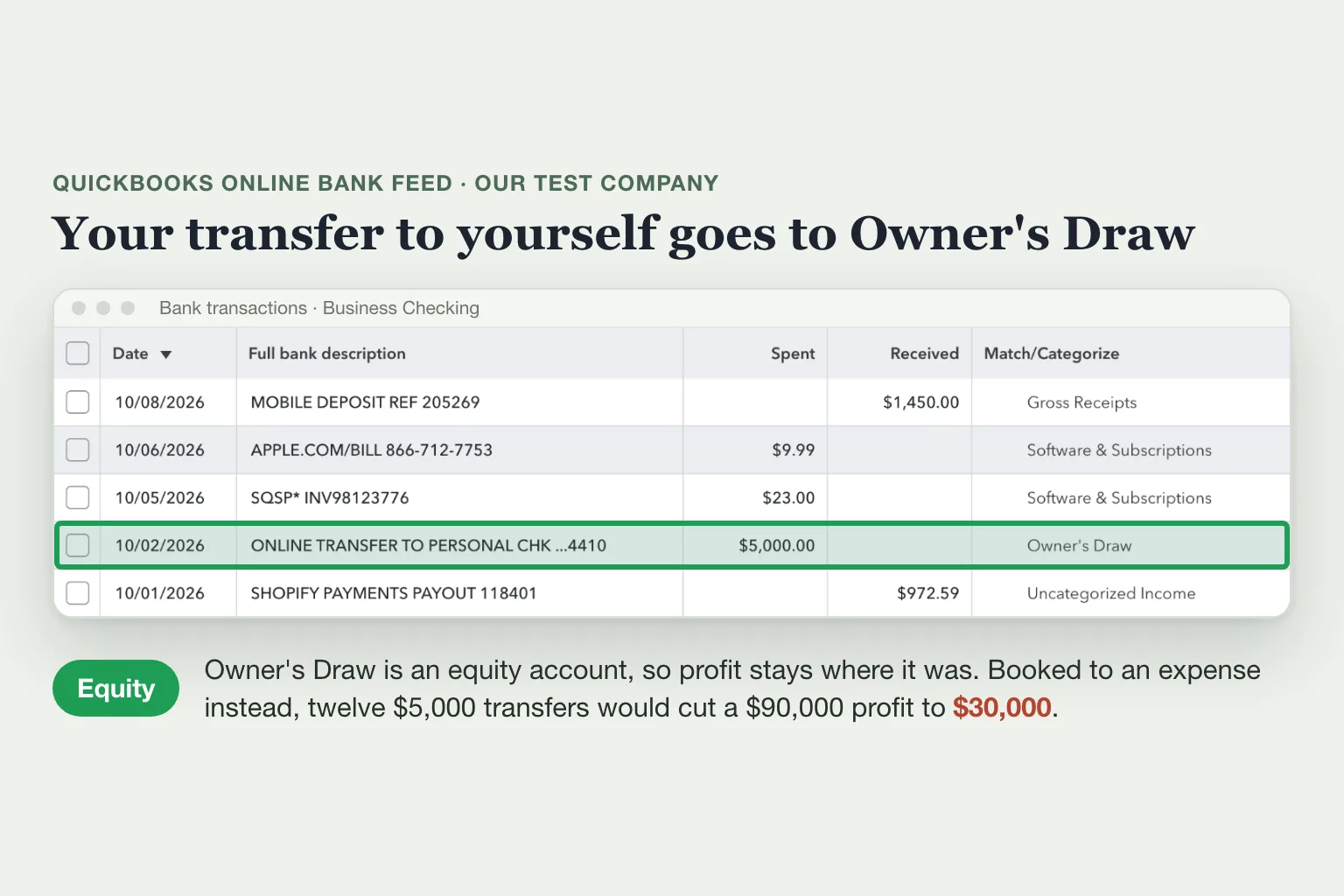
The draw doesn't lower your tax. For example, on $90,000 of net profit, self-employment tax is $12,716.60 whether you take out $10,000 or $60,000³. The draw can still throw off your books. Book $60,000 of draws to an expense account and the profit and loss report shows $30,000 of profit instead of $90,000.
We build Booke AI, AI bookkeeping software for QuickBooks Online and Xero.
How you pay yourself, by business type
Your business, for tax | You get paid by | Taxed on | In your books |
|---|---|---|---|
Single-member LLC (default) or sole proprietor | Owner's draw | Net profit: income tax and self-employment tax | Equity: Owner's Draw (drawings in Xero) |
Multi-member LLC (default) or partnership | Distributions, plus guaranteed payments if your agreement sets them | Your profit share on the K-1 and any guaranteed payments: income tax, usually self-employment tax | Distributions to equity; guaranteed payments as an expense |
S corp (LLC or corporation) | A reasonable salary through payroll, then distributions | Payroll taxes on the salary; income tax on the salary and your profit share | Salary through payroll; distributions to equity |
C corporation | Salary through payroll; dividends | Your wages and dividends | Salary through payroll; dividends to equity |
By default, the IRS treats a single-member LLC as part of its owner and a multi-member LLC as a partnership, and an LLC can elect to be taxed as a corporation². An eligible LLC or corporation files Form 2553 to be taxed as an S corporation⁴. If you're not sure which one you are, look at the last return: Schedule C with your own Form 1040 means a single-member LLC or sole proprietorship, Form 1065 a partnership, Form 1120-S an S corp, Form 1120 a C corporation.
How to pay yourself from a single-member LLC taxed by default
Keep the business's money in its own account, separate from your personal checking, as IRS Publication 583 advises⁵. Then transfer what you're taking to your personal account. If you write yourself a check, Publication 583 says to do that only when you withdraw money for personal use.
Record the transfer as an owner's draw, in equity. The steps for QuickBooks Online and Xero are below.
Set aside the tax. Nothing is withheld from a draw: you owe income tax and self-employment tax on the year's profit and generally pay it in quarterly estimated payments if you expect to owe $1,000 or more⁶.
Payroll isn't an option here: the owner of a single-member LLC taxed by default generally isn't an employee of the LLC⁷, and IRS Publication 334 says "You can't deduct your own salary or any personal withdrawals you make from your business"⁸.
Owner's draw vs salary: what each costs in tax
Owner's draw: the tax follows profit, not the draw
Say your single-member LLC made $90,000 of net profit this year and you drew $60,000. Self-employment tax is 15.3% (12.4% Social Security, 2.9% Medicare), charged on 92.35% of your net earnings³:
$90,000 × 92.35% = $83,115
$83,115 × 15.3% = $12,716.60
The draw isn't in that math, so the amount you take out doesn't change it, and your income tax is figured on the same profit. You can deduct half of the self-employment tax when you work out your income tax³.
That's why the draw has to stay out of your expenses. Quarterly estimates sized from a report that shows $30,000 instead of $90,000 come out too low, and whoever prepares your return from those books starts from the wrong number. A draw lowers equity on the balance sheet instead (see how net income and equity connect).
S corp: reasonable compensation through payroll, then distributions
Once your LLC is taxed as an S corp and you work in the business, you're its employee. The IRS requires "reasonable compensation" for your work before distributions, can reclassify distributions as wages when the salary is too low, and doesn't charge employment taxes on non-wage distributions⁹.
Same example, now taxed as an S corp: $90,000 of profit before your pay and a $60,000 salary, a figure picked only to show the math:
Social Security and Medicare on the salary: 15.3%, or $9,180. Half of it, $4,590, is withheld from your paychecks, and the company pays the other $4,590¹⁰.
Left in the company after your salary and its share of payroll tax: $90,000 − $60,000 − $4,590 = $25,410. That can come out as distributions without Social Security and Medicare tax.
Income tax still applies to both. Your salary is on your W-2, and the S corp's profit flows through to your personal return¹¹.
The IRS doesn't publish a salary number. Its factors include your training and experience, your duties, the time you spend on the business and what comparable businesses pay for similar services⁹. Don't read the gap between $12,716.60 and $9,180 as your saving: payroll costs, unemployment taxes, a separate S corp return and the salary you can defend all change it, so have your CPA run the comparison on your numbers.
Partners in a multi-member LLC: distributions and guaranteed payments
Partners don't get a W-2 from the partnership; distributions and guaranteed payments are reported on Schedule K-1 (Form 1065)¹².
Distributions are money you take out of the business. Record them to an equity account such as Partner Distributions¹³.
Guaranteed payments are amounts for your work or capital that are set without regard to the partnership's income. Nothing is withheld from them, the partnership generally deducts them as a business expense, and you report them as ordinary income¹⁴.
Your net earnings from self-employment, if any, are in box 14 of your K-1, and you report them on Schedule SE¹⁵.
How much should you pay yourself from your LLC?
How much you can draw comes down to what the business can spare after taxes and next month's bills. A monthly routine:
Close the month: every bank-feed line categorized, with draws in equity and none in expenses.
Read net profit on the profit and loss report for the year to date.
Set aside tax on that profit. Self-employment tax works out to about 14.1% of profit (92.35% × 15.3%) until your net earnings pass the Social Security wage base, $184,500 for 2026¹⁰, with federal and state income tax on top at your rates. The 2026 estimated payments are due April 15, June 15 and September 15, 2026, and January 15, 2027¹⁶.
Check the bank balance against the bills due next month and leave that cushion in the business.
Draw what's left, on the same day each month.
Steps 2 and 3 are only as good as the profit number. In our test of 7 Claude prompts on a made-up candle shop's year, Claude read profit from the raw bank export as $24,960.80. From the categorized QuickBooks report it got $34,401.74, the books' actual figure¹⁷. Size your draw and your tax set-aside from the first number and both start from a profit that's $9,440.94 too low.
How to record an owner's draw in QuickBooks Online and Xero
QuickBooks Online
Intuit's steps¹⁸:
If your chart of accounts doesn't already have one, add an account with the Equity type and the Owner's Equity detail type, named, for example, Owner's Draw. Our QuickBooks chart of accounts guide shows where to add it.
Pay yourself with a regular check against that account, not through payroll.
If you moved the money by bank transfer or Zelle, it shows up in your bank feed as a withdrawal. Categorize it to Owner's Draw instead of creating a check. In our test company, QuickBooks suggested Owner's Draw on its own for a line that read ONLINE TRANSFER TO PERSONAL CHK ...4410; check the suggestion before you click Post.
Xero
In Xero, money you take out for personal use is drawings. Code the bank line, or a Spend Money transaction, to your drawings account; personal expenses paid from the business account go there too¹⁹. If your chart doesn't have one, add an equity-type account such as Owner Drawings, or Partner Distributions for partners¹³.
S corp salary and distributions
Your salary runs through payroll like any employee's, with the taxes withheld. Record distributions to their own equity account, never to wages or an expense.
Check that last month's draws landed in equity
In the bank register or bank feed, find every transfer to your personal account and every Zelle or card payment that was for you.
Each one should be in Owner's Draw (drawings in Xero). None should sit in Uncategorized Expense, Payroll Expenses or an operating expense. Our guide to business expense categories shows where draws and other non-expenses go instead.
Money the business expects back is a loan to you, an asset in the books, not a draw¹. Owner contribution or loan covers the money going the other way.
Compare the Owner's Draw total on the balance sheet with what you actually took out this year.
Where Booke fits
Your draws arrive in the same bank feed as sales, card payments and supplier bills, and each one needs the right account before your profit and loss report is right. Booke works inside the QuickBooks Online or Xero books you already have, with the bank feeds already connected there. It categorizes and matches the routine lines using your business's own history and corrections, and unclear transactions are flagged for your decision; approved changes improve future QuickBooks automation. Booke automates up to 80% of manual bank-feed work for $129 per business per month. See how Booke works for small business owners.
FAQ
Can an LLC owner take a salary as well as draws?
Only if the LLC is taxed as a corporation. In an S corp you take both: a salary through payroll, then distributions⁹. Partners can't be on the partnership's payroll, but they can take guaranteed payments as well as distributions¹².
Is it legal to move money from the business account to my personal account?
Yes. That transfer is how you take a draw or a distribution. Record it in equity and keep the business account separate from your personal one, as in the steps above.
What's the difference between an owner's draw and a distribution?
Both are money an owner takes out of the business, recorded in equity. Intuit uses "owner draws" for sole proprietors and partnerships¹; partners and S corp shareholders usually call the same money a distribution.
Is an owner's draw taxed?
Not separately. Income tax and self-employment tax are figured on the business's net profit, its income minus its expenses³, and a draw is neither⁸. For partners, money distributed beyond your adjusted basis in the partnership is generally taxable gain¹⁴; your CPA tracks basis.
Sources
Intuit, What is equity?, updated August 5, 2026.
IRS, Limited liability company (LLC), reviewed October 10, 2026.
IRS, Topic no. 554, Self-employment tax, updated September 24, 2026.
IRS, About Form 2553, Election by a Small Business Corporation, reviewed March 30, 2026.
IRS, Publication 583, Starting a Business and Keeping Records, revised December 2024.
IRS, Estimated taxes, reviewed September 25, 2026.
IRS, Publication 3402, Taxation of Limited Liability Companies, revised March 2020.
IRS, Publication 334, Tax Guide for Small Business, for 2025 returns.
IRS, S corporation compensation and medical insurance issues, reviewed March 3, 2026.
IRS, Topic no. 751, Social Security and Medicare withholding rates, reviewed September 24, 2026.
IRS, S corporations, reviewed June 11, 2026.
IRS, Paying yourself, reviewed May 8, 2026.
Xero, Account for the distribution of income to owners and beneficiaries. Read October 9, 2026.
IRS, Publication 541, Partnerships, revised December 2025.
IRS, Partner's Instructions for Schedule K-1 (Form 1065), 2025.
IRS, Publication 505, Tax Withholding and Estimated Tax, 2026.
Vadim Chumak (@vadimvchumak), Where Did Your Business Money Go? 7 Claude Prompts. On a Bank Export, Profit Came Out $9,441 Short, X, October 25, 2026.
Intuit, Set up and pay an owner's draw, updated August 5, 2026.
Xero, Manage funds in and out of your business. Read October 9, 2026.

