
Outsourced bookkeeping: how it works, what it costs and when it pays

Outsourced bookkeeping means paying an outside bookkeeper or firm to keep your books every month: categorize bank and card transactions, match payments to invoices, reconcile the accounts and send you the reports. Many work inside your own QuickBooks Online or Xero file; some move the books to their own software. At the six US services we checked in October 2026, plans with a human bookkeeper started at $199 to $469 a month, before catch-up fees. It pays when the hours the books take you are worth more than that fee. It won't take every question off your desk: in our test month, 10 of 26 bank and card lines would still need the owner.
We build Booke AI, AI bookkeeping software for QuickBooks Online and Xero.
Three ways to get the monthly books done
Do it yourself | Outsourced bookkeeper | AI bookkeeper inside QuickBooks or Xero | |
|---|---|---|---|
Who sorts the bank feed | You or someone on staff | The bookkeeper, usually weekly or monthly | Software, every day |
Who answers the unclear lines | You | You, when the bookkeeper asks | You or your accountant, when the software asks |
Where the books live | Your QuickBooks or Xero file | Your file with the bookkeeper as a user, or the service's own software | Your file; the software is invited (QuickBooks Online) or connected (Xero) |
Monthly cost | Your time | $199 to $469 and up at the services we checked, plus catch-up | $129 per business for Booke, plus your time on its questions |
Fits when | Few transactions, and you like the work | You're behind, or need monthly reports someone else stands behind | Most of the work is a busy bank feed you'd rather not click through |
Many owners mix them: software or a bookkeeper for the month, and a CPA for year-end and taxes. If you keep the books yourself, our bookkeeping basics guide has a weekly routine for QuickBooks Online and Xero.
How outsourced bookkeeping works
The first weeks are setup. You give the bookkeeper access to your books and every account the business uses, and they catch up any months that are behind. After that, each month runs the same way:
The bookkeeper categorizes the month's bank and card transactions and matches customer payments to your invoices.
They reconcile each account: check that the books match the bank or card statement.
They send you a list of questions about the lines they can't settle from your records.
Once you answer, they close the month and send the reports, usually a profit and loss statement and a balance sheet.
In QuickBooks Online you invite the bookkeeper as an accountant user: Settings, Manage users, the Accountants or Accounting Firms tab, then Invite firm¹. An accountant invited this way doesn't count toward your plan's user limit¹. In Xero, your bookkeeper or accountant can use your organization as part of your subscription, at no extra charge².
Pros and cons of outsourced bookkeeping
Pros | Cons |
|---|---|
Someone trained categorizes and reconciles every month | You still answer the questions only you can: 10 of 26 lines in our test month |
Months that are behind get caught up | Finished numbers come after the month is closed, not day to day |
Reports arrive on a schedule your CPA or lender can use | Invoicing, bill pay, payroll and tax returns often cost extra |
Costs less than a full-time hire | Some services keep the books in their own software |
What outsourced bookkeeping costs
Prices depend on how many transactions you have, your revenue or monthly expenses, and how far behind the books are. These are the published US prices when we checked on October 31, 2026:
Service | Published price | What moves the price | Books kept in |
|---|---|---|---|
Bench | From $199 a month billed monthly, for revenue up to $250,000 a year; $399 a month standard³ | Revenue; current-year catch-up included with an annual plan | Bench's own software |
Merritt Bookkeeping | $250 a month, flat⁴ | No tiers; catch-up $200 per month behind | QuickBooks |
Pilot | $99 a month for AI bookkeeping up to $100,000 in monthly expenses; from $299 a month billed annually with a US bookkeeper⁵ | Monthly expenses | Pilot's setup; your existing QuickBooks account only on custom plans |
Intuit Expert Full Service Bookkeeping | From $300 a month, after a cleanup fee⁶ | The cleanup fee covers up to 20 months of past books | QuickBooks Online |
Bookkeeper360 | From $400 a month⁷ | Size and complexity; setup and catch-up from $1,000 | QuickBooks Online or Xero |
1-800Accountant Business Complete | $469 a month billed annually, with tax filing and payroll⁸ | Monthly transactions | Its own ClientBooks software |
Bench and 1-800Accountant keep the books in their own software, and Pilot keeps your existing QuickBooks account only on custom plans. If you pick one of them, ask how you get your books back when you leave.
If you're on QuickBooks Online Plus, check your plan before you pay anyone. At its $140 monthly list price⁹, Plus now includes monthly categorization of your bank transactions by an Intuit bookkeeping expert. When a transaction is vague, the expert won't guess and comes back to you. If an accountant is already attached to your file, you're opted out by default¹⁰. To compare Plus with the cheaper plans, see what each QuickBooks Online plan costs.
A full-time hire costs more than the wage. The median pay for bookkeeping, accounting and auditing clerks was $24.36 an hour, or $50,670 a year, in May 2025¹¹. In private industry, wages and salaries were 70.0% of employers' compensation costs in June 2026¹². Applying that private-industry average, a clerk at the median wage costs about $72,400 a year with benefits and payroll taxes, roughly $6,000 a month.
What the fee usually doesn't cover
Most monthly plans cover categorizing, reconciling and the monthly reports. Invoicing, paying bills, payroll, 1099s, sales tax returns and income tax returns often cost extra or stay with your CPA. Intuit's Expert Full Service Bookkeeping, for example, covers categorizing and reconciling and leaves out invoicing, bill pay, receivables and payables, payroll, 1099s and tax filing⁶. Ask for the list in writing before you sign.
What a bookkeeper will still ask you: one month from our test books
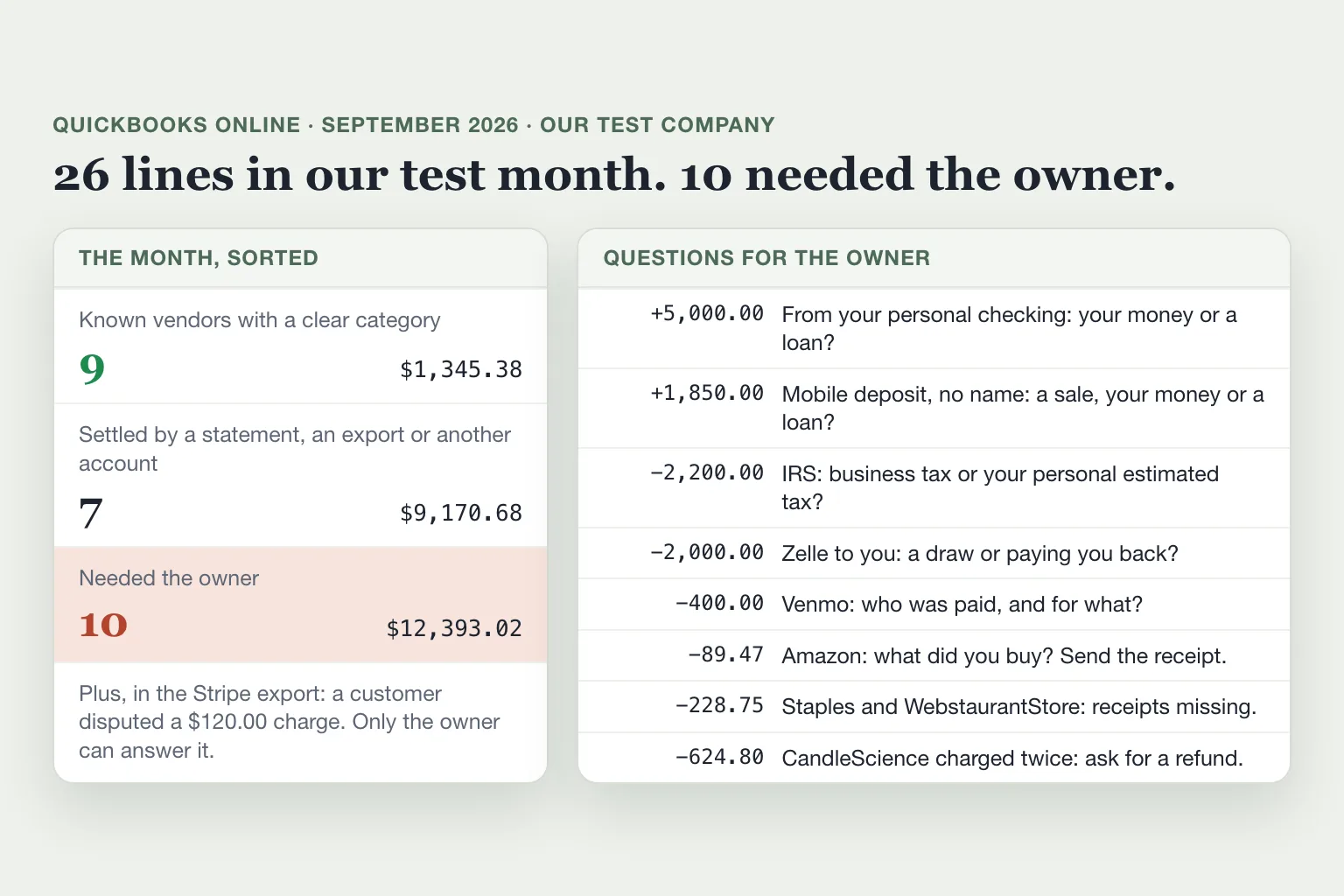
We took September 2026 from our QuickBooks Online test company, a candle business with made-up books that we seeded with the kind of bank and card lines owners get. It had 26 lines: 16 in checking and 10 on the business credit card. We sorted them ourselves with the answer key we wrote for this month; no bookkeeping service handled it.
What it took | Lines | Money moved |
|---|---|---|
Known vendors with a clear category: supplies, ads, shipping, software | 9 | $1,345.38 |
Settled by a statement, an export or another account once the bookkeeper can see it: two Stripe payouts, two transfers to savings, the card payment, the SBA loan payment, a customer's payment of an open invoice | 7 | $9,170.68 |
Needed the owner | 10 | $12,393.02 |
The nine known-vendor lines were the small ones, $1,345.38 in all. The 10 lines that needed the owner moved more than nine times as much. These are the questions the owner would get:
Line | Amount | The question |
|---|---|---|
Transfer from the owner's personal checking | +$5,000.00 | Did you put this in as your own money, or lend it to the business? |
Mobile deposit with no customer name | +$1,850.00 | Is it a sale, your money or a loan? Which customer? |
IRS payment | −$2,200.00 | Business tax, or your personal estimated tax? |
Zelle to the owner | −$2,000.00 | An owner's draw, or paying you back for something you bought for the business? |
Venmo payment | −$400.00 | Who was paid, and for what? |
Amazon order | −$89.47 | What did you buy? Please send the receipt. |
Staples, on the card | −$132.60 | Can you send the receipt? |
WebstaurantStore, on the card | −$96.15 | Can you send the receipt? |
CandleScience, on the card, charged twice | −$312.40 × 2 | Same order, two charges. Can you ask the supplier for a refund? |
That's six questions, two missing receipts and one double charge. The Stripe export added one more item: a customer disputed a $120 charge.
Whoever keeps the books, these answers come from you: only you know what the money was for and where the receipts are. The first one is the owner contribution or loan question, and the answer changes the balance sheet. Some answers move the profit by themselves. Our balance sheet vs income statement guide takes this same September and moves the transfers, card payment, loan principal, the customer's invoice payment and the owner's money off the profit and loss statement. The month then shows a $1,800.50 profit if the $1,850 deposit is a sale, and a $49.50 loss if it's owner money.
What to hand over on day one
Most of these settle lines like the ones above before anyone has to ask you:
Access to your QuickBooks Online or Xero file as a user. Keep yourself as the primary admin.
Every account the business uses: checking, savings, cards, loans and payment apps such as Stripe, PayPal or Square. Bank feeds are best; monthly statements also work.
Loan statements, so each payment can be split into principal and interest. Our SBA payment of $1,150.00 was $980.40 principal and $169.60 interest.
Open invoices and unpaid bills, so customer payments can be matched to them.
Your receipts and your rule for them, for example a receipt for every purchase over $75.
Last year's tax return and your CPA's contact, so the opening balances match what was filed.
If your bookkeeper handles bills, keep payment approval for yourself: they record and schedule, you approve and send.
When outsourced bookkeeping pays
Do the math with your own numbers:
Your cost now: the hours a month you or your staff spend on the books, times what an hour of that time is worth to the business.
The service: its monthly fee, plus the time you'll still spend answering its questions and sending receipts.
Software inside your books: its price, plus your time on its questions.
Outsourcing pays when the second number is lower than the first, and software pays when the third is. Outsourcing also pays when being behind costs you: a lender asking for current statements, a tax deadline with three months still uncategorized, or reports you can't trust enough to price your products.
It pays less when most of your lines are known vendors and the job is mostly clicking through the bank feed. That's the part software does well. In our test month, those were 9 of the 26 lines and the smallest by money.
How to choose an outsourced bookkeeper
Start with the kind of provider. A freelancer may cost less, but one person out sick can stall your month; a firm or online service usually has someone to cover, and a CPA firm can add the tax work. Then check that:
They work in your QuickBooks Online or Xero file, not a copy in their own system.
The fee says what it covers: how many accounts and transactions, catch-up months, and when the monthly reports arrive.
Questions come once a month in one list, with a date by which they need your answers.
You know who checks their work, and whether a CPA reviews it.
Leaving is simple. In QuickBooks Online, a primary or company admin removes an accountant user and access ends right away¹³.
Ask to see a sample month-end question list; it shows how the service will work with you better than a sales call can.
How to check the outsourced work each month
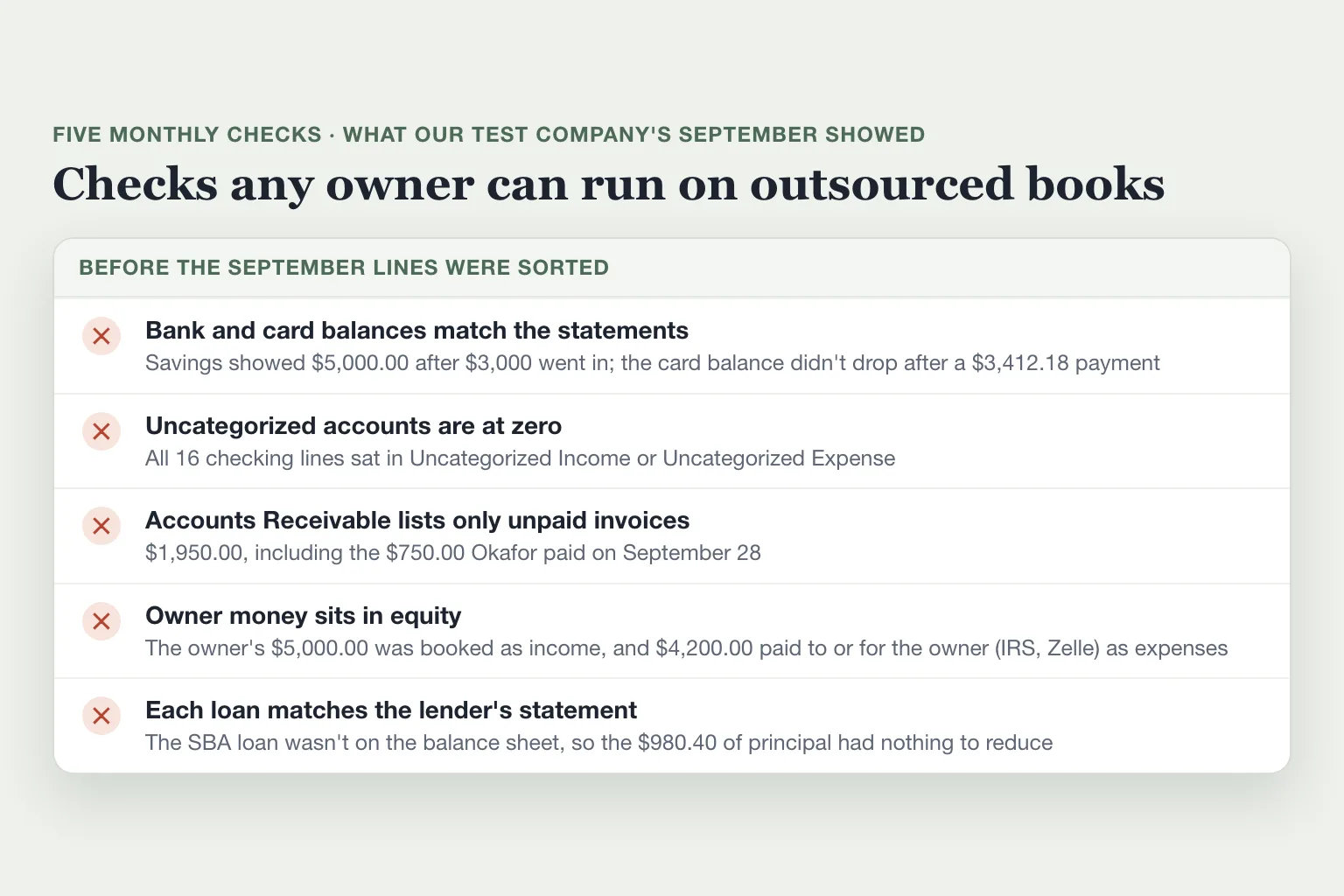
You don't need accounting training for these five checks:
Every bank and card balance in the books matches the statement for the same date. Our guide on how to reconcile in QuickBooks Online shows how to check it.
Uncategorized Income, Uncategorized Expense and any Ask My Accountant account are at zero, or you know what's still in them.
Accounts Receivable lists only invoices customers still owe you.
Money you put in or took out shows up in equity, the owner's part of the balance sheet, not in income or expenses.
Each loan balance matches the lender's statement.
Our test month failed all five before its lines were sorted. Most lines sat in uncategorized accounts, savings didn't show the transfers and the card balance didn't drop after the payment. The SBA loan wasn't on the balance sheet, a paid invoice was still open, and the owner's $5,000 was booked as income.
Where Booke fits
The nine known-vendor lines in our test month are the kind of work Booke takes on. Booke is an AI bookkeeper that works inside the QuickBooks Online or Xero books you already keep and goes through your bank feed every day. It categorizes transactions to the accounts in your chart, matches customer payments to the invoices they pay and brings you only the transactions that need you, or your accountant if you prefer. Booke automates up to 80% of manual bank-feed work for $129 per business per month. Your accountant keeps checking the books monthly or at tax time.
Your math: what you spend on bookkeeping now, minus the value of the time you'll still spend on questions, minus $129. See how Booke works for small business owners.
FAQ
Is it worth outsourcing bookkeeping for a small business?
Yes, when the fee plus your time on its questions costs less than your time on the books now, or when being behind is costing you money. The section on when outsourced bookkeeping pays has the three numbers to compare.
How much does outsourced bookkeeping cost?
At the six US services we checked in October 2026, plans with a human bookkeeper started at $199 to $469 a month. Catch-up often costs extra, for example $200 per month behind at Merritt Bookkeeping. A full-time bookkeeping clerk at the median wage costs roughly $6,000 a month with benefits and payroll taxes, by our estimate from BLS data¹¹ ¹².
What's the difference between a virtual bookkeeper and an outsourced bookkeeper?
Usually nothing. Both work remotely in your accounting software. "Virtual bookkeeper" more often means a freelancer, and "outsourced bookkeeping service" a firm with a team and a fixed monthly plan.
Can my CPA do my bookkeeping?
If their engagement includes it. Tax preparation and monthly bookkeeping are separate jobs: some firms sell both, and 1-800Accountant bundles them in one plan⁸. Ask what your current fee covers.
Is AI replacing bookkeepers?
AI handles more of the repeat categorizing, and the Bureau of Labor Statistics projects employment of bookkeeping, accounting and auditing clerks to fall 6% from 2025 to 2035¹¹. People still answer the questions that depend on what the owner meant and check the books before taxes. More in will AI replace accountants.
How long should I keep records if someone else keeps my books?
The same as if you kept them yourself: the IRS says to keep records for at least three years in most cases, four years for employment taxes and longer in some situations¹⁴. Your bookkeeper keeping copies doesn't move that responsibility to them.
Sources
Intuit, Invite accountant users, updated August 28, 2026.
Xero, Bookkeeping software for small businesses, retrieved October 31, 2026.
Bench, Pricing, retrieved October 31, 2026.
Merritt Bookkeeping, Pricing, retrieved October 31, 2026.
Pilot, Pricing, retrieved October 31, 2026.
Intuit, Full Service Bookkeeping, retrieved October 31, 2026.
Bookkeeper360, Pricing, retrieved October 31, 2026.
1-800Accountant, Pricing, retrieved October 31, 2026.
Intuit, QuickBooks Online pricing, retrieved October 31, 2026.
Intuit, Expert bookkeeping help in QuickBooks Online, updated August 24, 2026.
U.S. Bureau of Labor Statistics, Bookkeeping, Accounting, and Auditing Clerks, Occupational Outlook Handbook, modified August 27, 2026.
U.S. Bureau of Labor Statistics, Employer Costs for Employee Compensation, June 2026, released September 9, 2026.
Intuit, Remove an accountant user, updated August 5, 2026.
IRS, How long should I keep records?, updated June 30, 2026.

